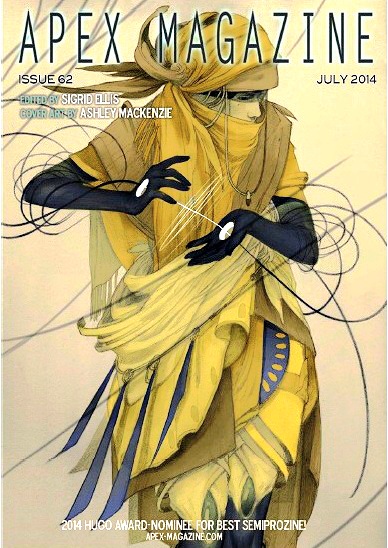
I am very much saddened to hear about the death of Maureen K Speller. She was a fantastic editor and critical beta reader who helped me with my stories “Blessed are the Hungry” and “Dyschronometria, or The Bells are Always Screaming”. My deepest condolences to her family.
Maureen Kincaid Speller was a critic and reviewer. She was Senior Reviews Editor at Strange Horizons, and Assistant Editor of Foundation: the International Review of Science Fiction. She also reviewed for Interzone and Vector. She was a former Arthur C. Clarke Award judge, and a former James Tiptree Jr. Award judge.
A.I. generated art has been around for years. But tools released this year like DALL-E 2, Midjourney and Stable Diffusion — have made it possible for visual-art challenged people like myself to create fairly complex, abstract or photorealistic works simply by typing a few words into a text box.
These are my first attempts to illustrate some of my stories using Midjourney AI. Not incredible but not to shabby either. I could actually use some of these as e-book covers.
However, I am still on the fence about the ethics of A.I.-generated art. Are they a real emergent art form or a high-tech form of plagiarism? WDYT?
“Blessed are the Hungry” – this one came out the best. Funny how the rendered image looks like my youngest daughter.
“I ducked out of sight as soon as I saw the wolf-like mecha, shrouding my lantern with my shirt. Frightful as they were, I was mesmerized by their strange beauty. In the half-light of the Holosonic, their liquid-armor bodies shimmered purple, vermillion and bronze. I imagined these to be the colors of a sun that I had never seen, the burial clothes of a mother-star that we had abandoned so long ago.”
“Infinite Degrees of Freedom” – the blurry shape in the background is Midjourney unable to render a mythical sigbin monster in a spaceship corridor. Why does the kid from my story look like a young Rodrigo Duterte?
“From out of nowhere, Deo smelled an immensely foul odor, a rotting stench filled with the smell of death. A shape coalesced from the blackness, swiftly moving, gibbering, and utterly horrible. A sigben, a vicious half-dog/half-lizard chimera from ancient Philippine Myth had come for him. The impossible monster blocked his path and let loose a frightening roar-bark loud as a thunder clap.”
“Mene, Thecel, Pares” – My account expired before I could redo this with a steampunk Berlin in the background. The protagonist, Joseph Mercado (a fictionalized Jose Rizal) looks a bit cross-eyed.
“Joseph wished he didn’t have to remove his mask. Everywhere he went, people stared at him. Without his mask’s protection, the city’s xenophobic populace would peer from windows or point as he walked past whispering “fremde, außerirdische, ausländer, Asiaten, Japaner, Chinesischer Mann, Korean Mann” –- anything but his own ethnicity.”
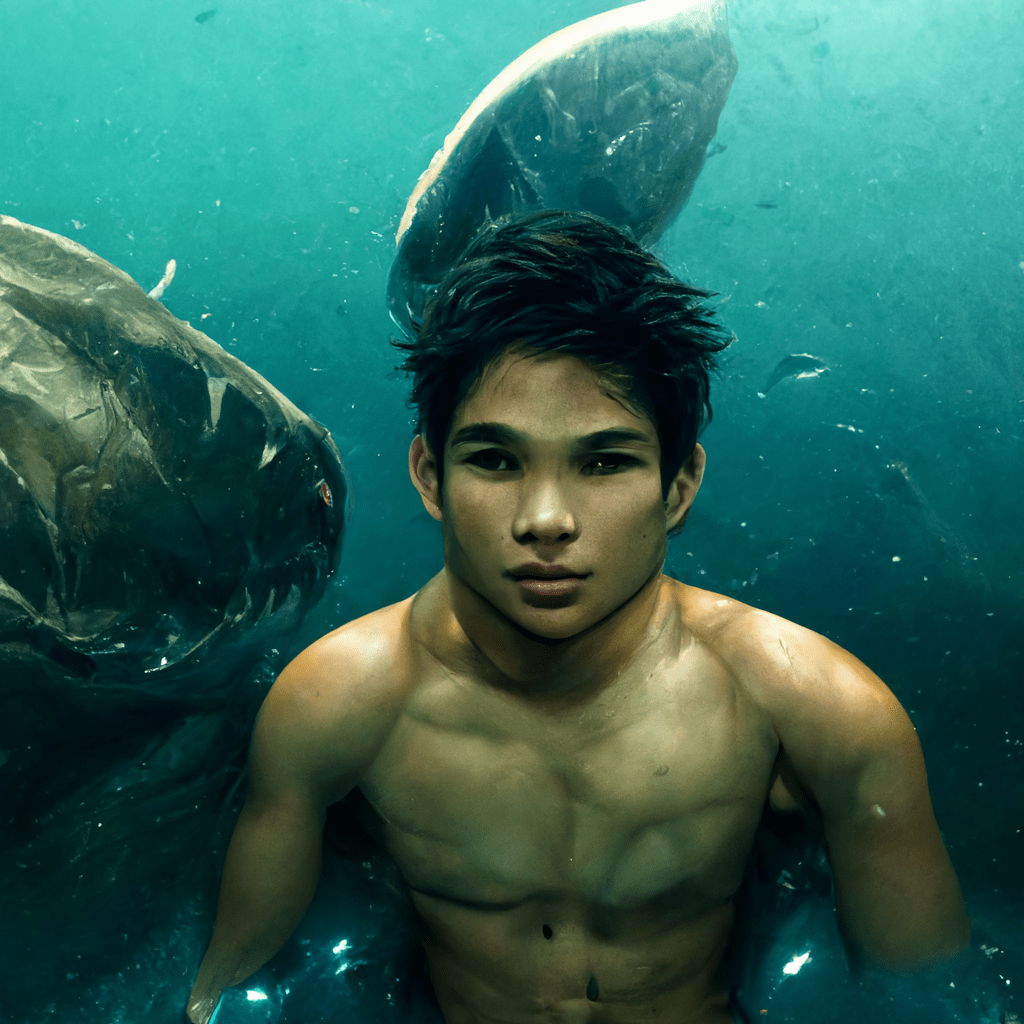
“Carry That Weight” – This is supposed to be the older brother, Berto. The two blobs in the background are supposed to be megamouth sharks. Also, the boy’s hair shouldn’t look like that underwater. Must be industrial-strength aquanet.
“The smaller boy watched as his brother fished out a pair of smart goggles from his shorts pocket and clipped his phone to his wristband. Berto’s body was dark and tightly muscled. He seemed naked save for the skintight nanotech body suit that kept his body warm and protected it from the sun’s radiation.“
Reading-Dialogue across the Sea between Get Luckier Sg/Phil writers
This Poetry Festival Singapore will take place from July 29 to August 10 this year in various locations across the island. Please join us this 30 July for a special event “Reading-Dialogue across the Sea” between Get Luckier Sg/Phil authors, with Singapore-based writers Paul Jerusalem, Migs Bravo-Dutt, Victor Ocampo, Reah Maac, Cathy Candano and Filipino poets Wilson Lee Flores, Wendell Capili, Jo Em Antonio, Cristina Montes, Mariela Lansang with spoken word poet LKN as host (and Cathy Candano as technology expert). The recording will be done from 8pm onwards. Stay tuned for the announcement of the online broadcast.
Get Luckier – An Anthology of Philippine and Singapore Writings II (Editors Migs Bravo Dutt, Claire Betita de Guzman, Aaron Lee Soon Yong and Eric Tinsay Valles) is the sequel to the much-loved original Get Lucky from six years ago. It features writing that illustrate how technology, the pandemic and other current events have impacted the fellowship between Singaporeans and Filipinos.
The landmark anthology Fish Eats Lion: New Singaporean Speculative Fiction collected the best original speculative fiction written in Singapore in or around 2012. It was the first local anthology that treated the literature of the fantastic as bona fide literary work, instead of simply just genre. Edited by Jason Erik Lundberg, this book included stories by Ng Yi-Sheng, Neon Yang, Daryl Yam and Shelly Bryant, who would all become leading lights in the APAC Spec Fic sphere, as well as works by mainstream fictionists who were not generally known for fantastical writing such as Grace Chia, Dave Chua, Noelle de Jesus, Isa Kamari, and Cyril Wong.
It’s been ten years since the original FEL and Jason has commissioned a follow-up anthology. I am very happy to be part of both books but it’s also a bit of a shock to realize that I’ve been getting published for so long. In my mind I am still a new writer struggling to get stories written and published (when I am not doing my day-job or house work, that is).
Congratulations to our evergreen editor Jason Erik Lundberg and to everyone on the new antho’s TOC. I can’t wait to read these new stories!
“Moreover, some stories explore the world between literary and genre fiction. It’s the best of both worlds, and it’s a noteworthy addition to a meager selection of Filipino sci-fi books.“
I also have a short story, “Infinite Degrees of Freedom” in the first book he discussed, Science Fiction: Filipino Fiction For Young Adults (Quezon City: UP Press, 2016). This work was also translated into Chinese and appeared in Science Fiction World‘s March 2017 issue. The story concerns the rocky relationship between a distant father and his emotionally needy son, programmable matter, guns that fire bolts of electricity, chicharon and a mythical sigben monster loose inside a rickety old spaceship.
I firmly believe in the transformative power of Science Fiction in nation building. As historian Yuvel Noah Harari said: “Today science fiction is the most important artistic genre… It shapes the understanding of the public on things like artificial intelligence and biotechnology, which are likely to change our lives and society more than anything else in the coming decades.”
But we must be conscientious with what we choose to write. The stories we dream up could very well be the bedrock upon which the next generation of Filipinos will build the future.
Congratulations to mentor/teacher, screenwriter, journalist, novelist, and playwright, Ricardo “Ricky” Lee on being conferred the Order of National Artists (ONA), together with seven other distinguished Filipino artists from various disciplines.
His extensive body of work, spanning over four decades, include short stories, plays, essays, novels, teleplays, and screenplays. Two of his short stories won first prizes at the Don Carlos Palanca Memorial Awards for Literature (1970 and 1971). His screenplay “Salome/Brutal” won the 1981 Philippine National Book Awards for best screenplay. In 2011, he was awarded the Manila Critics Circle Special Prize for a Book Published by an Independent Publisher. His two-stage plays Pitik-Bulag sa Buwan ng Pebrero and DH (Domestic Helper) played to SRO crowds. DH, starring Nora Aunor, has toured the US and Europe in 1993.
However, Ricky Lee is best known for being a script writer. In fact he is the Philippines’ greatest and most prolific screenwriter, having written almost 200 screenplays, including classics such as “Brutal” (1980) and “Karnal” (1983), both directed by Marilou Diaz-Abaya; “Himala” (1982), by Ishmael Bernal; “Macho Dancer” (1988), by Lino Brocka; and “José Rizal” (1998), again, by Diaz-Abaya.
On top of all that, he is also the author of the definitive screenplay manual, Trip to Quiapo which distilled all the knowledge and wisdom he had amassed over the decades.
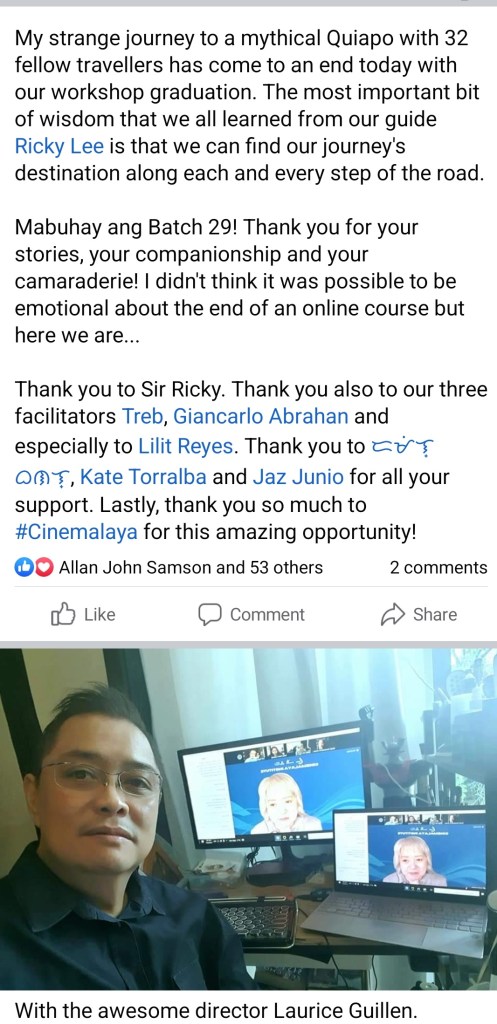
It was truly a great privilege for me to have been one of his students at Cinemalaya’s Ricky Lee Script Writing Workshop last year (Batch 29). Sir Ricky was truly one of the best literature teachers I have ever had — particularly with how he emphasized how characters and character development was the most important part of weaving any story. Being primarily a science fiction writer, it was especially important for me to be reminded that people followed stories for their characters rather than for the plot, regardless of how fantastical or technologically awesome the latter may be.
One of the things that most stuck to me was: “Lahat ng kahon ay oportunidad para mapilitan kang gumawa ng butas upang makalabas.” To (poorly) translate and paraphrase: “All the things that keep your character in a box are opportunities for them to escape (and further the plot).”
Both his book and his lectures some everything up with the idea of the writer as active participant, not only in his work but in the world outside it. As a recent article by Jerome Gomez of ABS-CBN puts it: “In Ricky Lee’s universe, everyone is a writer because we all have the power to reverse fortunes, change the course of history, by touching other people’s lives in ways big or small.”
Join us on Thursday, 14 July 2022 at 07:30-9pm at the Crane Club, 281 Joo Chiat Road (Osprey Room).
Featuring: Laetitia Keok, myself and Monique Truong’s THE SWEETEST FRUITSEventbrite Tickets: $5.00 ($6.32 with taxes and fees)
An imprint of Singapore Unbound, Gaudy Boy publishes Asian authors from around the world. Our growing list includes such terrific writers as Monique Truong, Alfian Sa’at, Lawrence Lacambra Ypil, Victor Fernando R. Ocampo, Jhani Randhawa, Jenifer Sang Eun Park, and Tania De Rozario, among others. Our books have been reviewed in Publishers Weekly and Necessary Fiction; noted in The Paris Review, Poets & Writers, LitHub, Electric Literature, The Millions, Ms. Magazine, TimeOut, ArtsEquator, and Words Without Borders; and long- or shortlisted for The Believer, Lambda Literary, and Association for Asian American Studies awards. Come hear our authors and editors read from their work and talk about publishing with Gaudy Boy.
Victor Fernando R. Ocampo is the author of the International Rubery Book Award-shortlisted The Infinite Library and Other Stories (Math Paper Press, 2017 ; US edition: Gaudy Boy, 2021) and Here be Dragons (Canvas Press, 2015), which won the Romeo Forbes Children’s Story Award in 2012.
Laetitia Keok is a writer and editor from Singapore. Her work has been nominated for the Pushcart Prize, and published in Wildness Journal and Hobart Pulp, amongst others. She edits for Gaudy Boy and Sine Theta Magazine. You can find her at laetitia-k.com
With brilliant sensitivity and an unstinting eye, Monique Truong’s novel The Sweetest Fruits circumnavigates the globe, introducing three unforgettable women separated by geography and culture but connected by their love for the Greek-Irish author Lafcadio Hearn (1850-1904). Gaudy Boy’s edition comes with a new afterword by the author.
Thank you so much to Justine Villanueva for reviewing my Romeo Forbes award-winning story “Here Be Dragons” for The Halo Halo Review (which publishes critical reviews, introductions, and other engagements with the English-language works of Filipino authors of all genres). Justine is a children’s books author and the founder of Sawaga River Press, a nonprofit that publishes children’s books featuring Filipino children and their experiences in the diaspora.
Sadly, this picture book is no longer in print. However, this work is included in my short story collection The Infinite Library and Other Stories (Singapore: Math Paper Press, 2017; New York: Gaudy Boy, 2021).
If the recent unfortunate turn of events in the Philippines has brought you down, remember that literature is here to salve the hurt and perhaps also offer a way to move forward. Please join fictionist and editor, Gabby Lee and myself as we talk about how speculative fiction can plant the seeds of hope during a time of great darkness.
This online discussion will be hosted by the good people of The Filipino Alliance at Brown University in Providence, Rhode Island on 12 May, at 8pm EST (8am in Singapore/Manila). Please use this link to register or scan the QR code below.
As promised, here’s a teaser from my chapter of Mapping New Stars: A Sourcebook on Philippine Speculative Fiction (Editors: Gabriela Lee and Anna Felicia Sanchez, UP Press pre-publication) – This is the first-ever collection of non-fiction essays and think pieces about about Philippine Speculative Fiction, written by many authors, academics and critics who are active in the field. My research on “The Roots of Speculative Fiction in the Philippines” grew from my 2014 attempt at documenting the early days of local Science Fiction (check out my original post here). For this chapter, I tried to identify the earliest known Filipino works that could be reasonably argued as Fantasy, Horror, and of course, Science Fiction.
Here’s the introduction:
Stories of the fantastic have existed in the Philippine Islands for as long as there have been people to tell them. From the earliest folk tales born in the depths of pre-Hispanic history, to the forms of literature that were introduced and evolved during the colonial period, to the rise of modernism and post-colonial writing that arrived after the birth of the republic, “speculative” fiction that explores the human condition through the unreal or the otherworldly continues to thrive and to grow because it speaks to something deep within readers that cannot be addressed by realism.
Cover of Doktor Kuba by Fausto J. Galauran M.D. Manila: Limbagan Nina Ilagan at Sañga, 1933
Contemporary “Filipino speculative fiction” as a category and domain of cultural activity can be said to have properly begun only in 2005, with the arrival of its first deliberate and sustained platform – the Philippine Speculative Fiction anthology series (edited by Dean Francis and Nikki Alfar). But what about texts that were not explicitly labeled “speculative fiction” by their authors, or were published prior to the first Philippine Speculative Fiction (PSF)? Let’s take a look at how deep the roots of the literature of the fantastic have dug into our history. How far back they go may surprise you.
I. Defining Speculative Fiction in the Philippine Context
“Every enthusiasm aspires to respectability,” Science Fiction Grandmaster Isaac Asimov once said about his chosen field of writing, “and one way of getting it, is to demonstrate that it is old, even ancient.[1]”
He goes on to say that by broadening Science Fiction’s definition to encompass “the branch of literature that deals with the imaginative and the unfamiliar”, it could be induced that Science Fiction is as old as literature itself.
Although Asimov walks this back to a more narrow definition later, his initial, expansive definition of science fiction to include everything non-realist and fantastical is, in fact, one of the accepted historically located meanings for the term “speculative fiction”[2]. In this context, speculative fiction is defined as a supercategory of literature that includes fantasy, horror and science fiction, as well as their derivatives, hybrids, and cognate genres like the gothic, dystopia, weird fiction, post-apocalyptic fiction, ghost stories, superhero tales, alternate history, steampunk, slipstream, magic realism, fractured/subverted folktales, and all their related sub-genres. It encompasses, what fictionist and editor Dean Francis Alfar noted as “at its core, the literature of the fantastic[3]”.
Marek Oziewicz, the Marguerite Henry Professor of Children’s and Young Adult Literature at the University of Minnesota, said that a story falls under the realm of speculative fiction if it has “speculative fiction sensibilities” i.e. it contains speculative elements that are based on conjecture and do not exist in the real world. These non-realist stories can also be filed under one of the genres covered by the speculative fiction umbrella.
Excluded from our definition of speculative fiction are ethno-epics, tribal myths and legends, as well as traditional fairy and wonder tales which fall under the category of folktales. These are anonymously authored literary artifacts, passed primarily through oral narratives. Also excluded are children’s stories and juvenilia, which is a branch of literature on its own.
Philippine speculative fiction is simply the spectrum of all genre work in fantasy, horror and science fiction (as well as their sub-genres) united by a Philippine identity and a coherent Filipino aesthetic.
Prior to the arrival of the first volume of Philippine Speculative Fiction in 2005, the term “Philippine speculative fiction” didn’t exist. Realism was (and remains) the most popular literary mode. Any work that existed outside this scope was marginalized[4]. As both PSF founding editors, the Alfars, lamented in the introduction to the first volume of PSF:
“If you look for speculative fiction in the Philippines, you will be dismayed. Science Fiction and the literature of the fantastic are in very small numbers and are still looked down upon as inferior…”.
Yet despite this realist bias, there are many pre-PSF works of Filipino literature that demonstrate speculative sensibilities that can readily be classified under speculative fiction’s umbrella genres of fantasy, horror and science fiction.
[1] Asimov, Isaac, The Birth of Science In Fiction (New York: Knightsbridge, 1981), p 9
[2] Oziewicz, Marek, “Speculative Fiction”, Literature, Oxford Research Encyclopedia, 29 March 2017
[3] Alfar, Dean Francis, “Introduction”, Philippine Speculative Fiction Volume 2 (Pasig: Kestrel, 2006), p IX
[4] Alfar, Dean Francis, “An Introduction”, Philippine Speculative Fiction Volume 1 (Pasig: Kestrel, 2005), p vii
Mapping New Stars: A Sourcebook on Philippine Speculative Fiction (Editors: Gabriela Lee and Anna Felicia Sanchez, UP Press pre-publication – likely the end of 2022 or early 2023).
BTW, I’ve decided not to post my unedited original text for the Science Fiction section due to — reasons. Instead I will (eventually) post the intros to Fantasy, Horror and Science Fiction sub-sections, as well as the chapter intro you see here.







 The Infinite Library and Other Stories