Thank you to Kenneth Yu and Mia Tijam for giving my (sort of) science fiction fairytale “The Ocean Above her” a home in Philippine Genre Stories.
My wife and I both went through life-threatening illnesses over the last year, and consequently my writing productivity was very poor. I’m happy I managed to complete this story given how trying our circumstances were.
I had originally wanted to write a literal children’s fairy tale but I could not manage to keep the language simple enough for a pre-teen to understand without losing the heart of the story. Although this generation ship Sci-Fi story is no longer specifically written for kids, I hope I was able to capture that sense of wonder that children have when encountering something astonishing, as well as the bewilderment that comes when facing something as dark and painful as the death of someone they love.
I also wanted to challenge the notion that a far-future story had to be written in a cold, technobabble-filled manner. I wanted a future like the handwoven inabel blankets my grandmother used to buy for us when we were children – something warm, comforting and familiar.
My humble submission is PGS’ story for December, but it’s not a Christmas story. However if you want to read something about endings and beginnings, familial love, and the importance of remembering, please read The Ocean Above Her. If you like it, kindly leave me a comment or RT. Thank you!
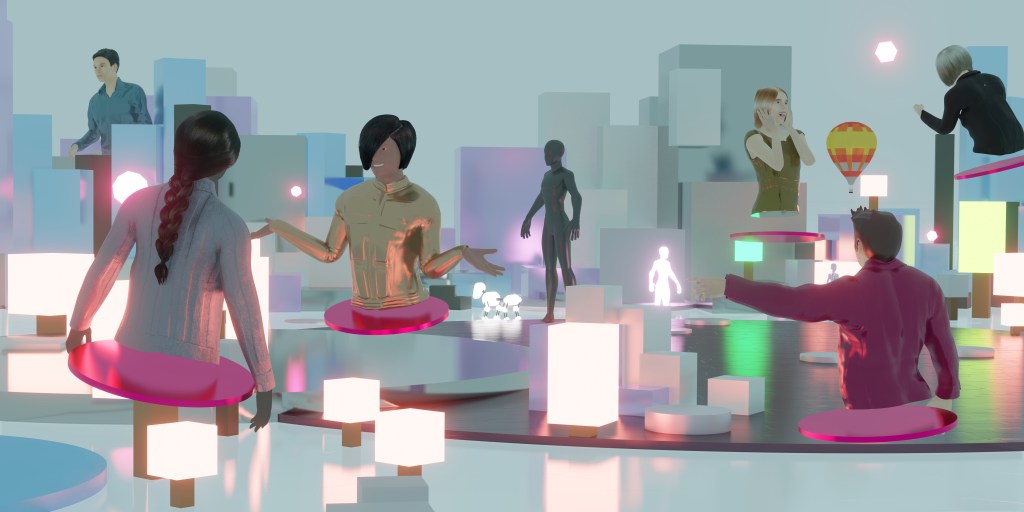
Thanks again to Lian Connect and the British Fantasy Society for inviting me to participate in this wonderful festival. Here’s a screen shot from the event:
Please join us tomorrow, Sept 22, 2024, from 11:00am to 4:30 pm BST, for 𝐈𝐦𝐚𝐠𝐢𝐧𝐚𝐫𝐢𝐮𝐦: 𝐀 𝐃𝐞𝐛𝐮𝐭 𝐅𝐞𝐬𝐭𝐢𝐯𝐚𝐥 𝐂𝐞𝐥𝐞𝐛𝐫𝐚𝐭𝐢𝐧𝐠 𝐄𝐒𝐄𝐀 𝐒𝐩𝐞𝐜𝐮𝐥𝐚𝐭𝐢𝐯𝐞 𝐅𝐢𝐜𝐭𝐢𝐨𝐧 𝐚𝐧𝐝 𝐀𝐮𝐭𝐡𝐨𝐫𝐬, an online Zoom conference with Lian Connect in partnership with the British Fantasy Society, in honour of ESEA Heritage Month.
Join Xueting Christine Ni (“Sinophagia”, “Sinopticon”), illustrator Sinjin Li, P.H. Low (“These Deathless Shores”), and myself with Elaine Chiew (moderator) as we explore if an “East South East Asian speculative fiction aesthetic” exists — or if can one even be defined.
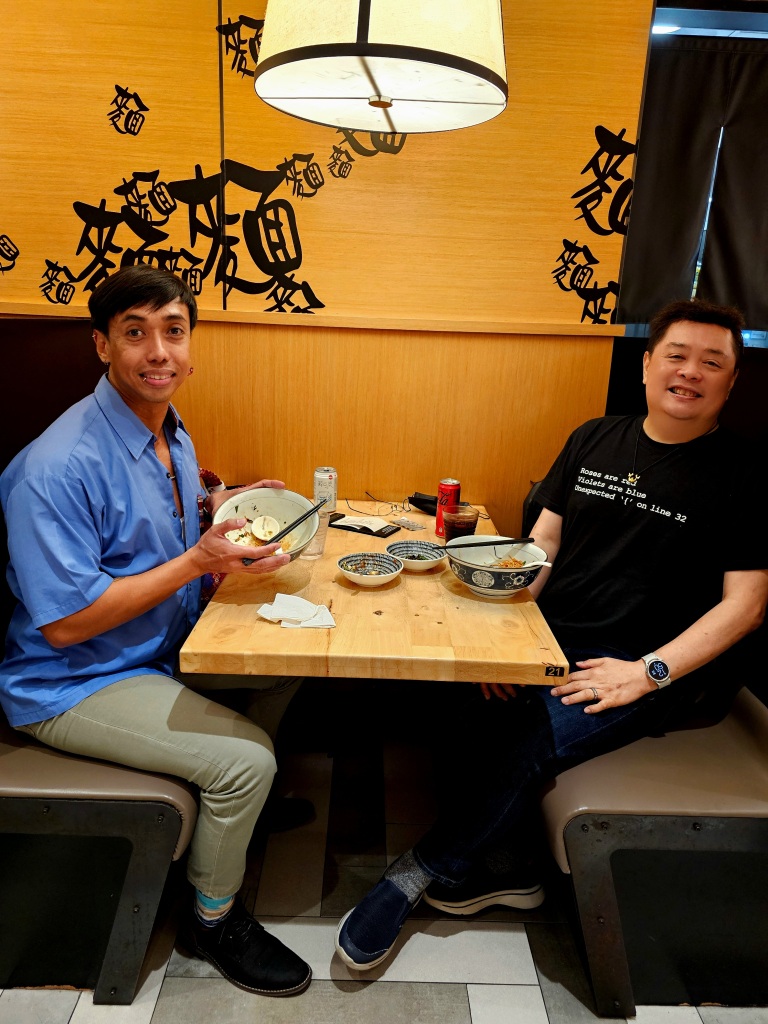
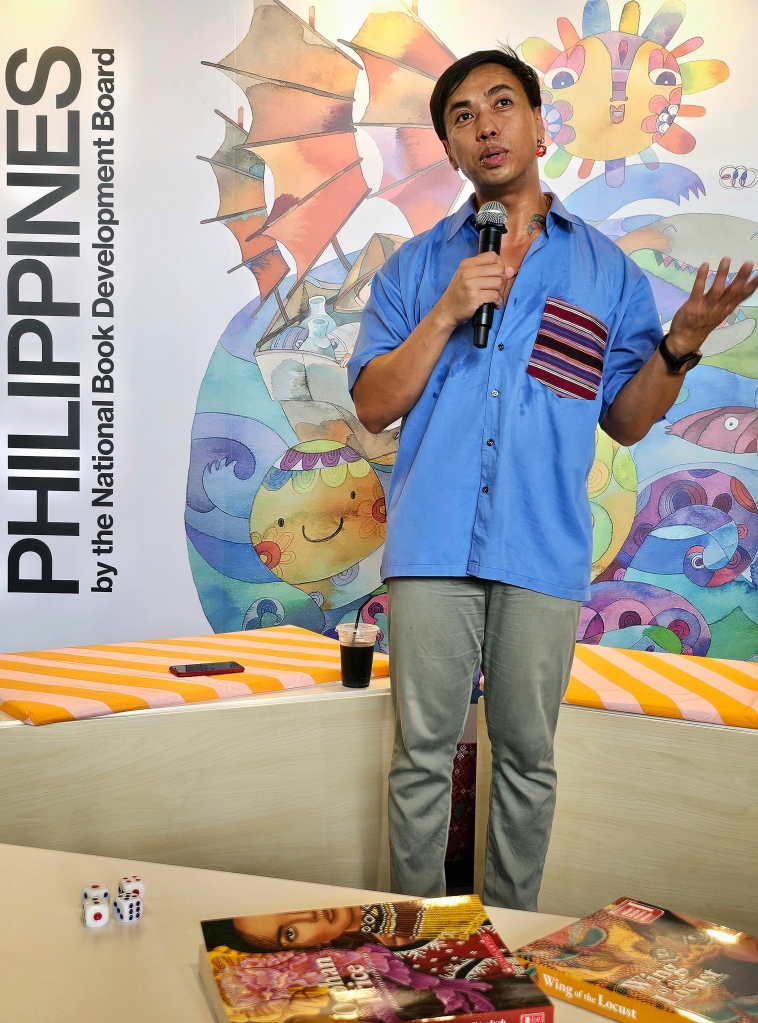
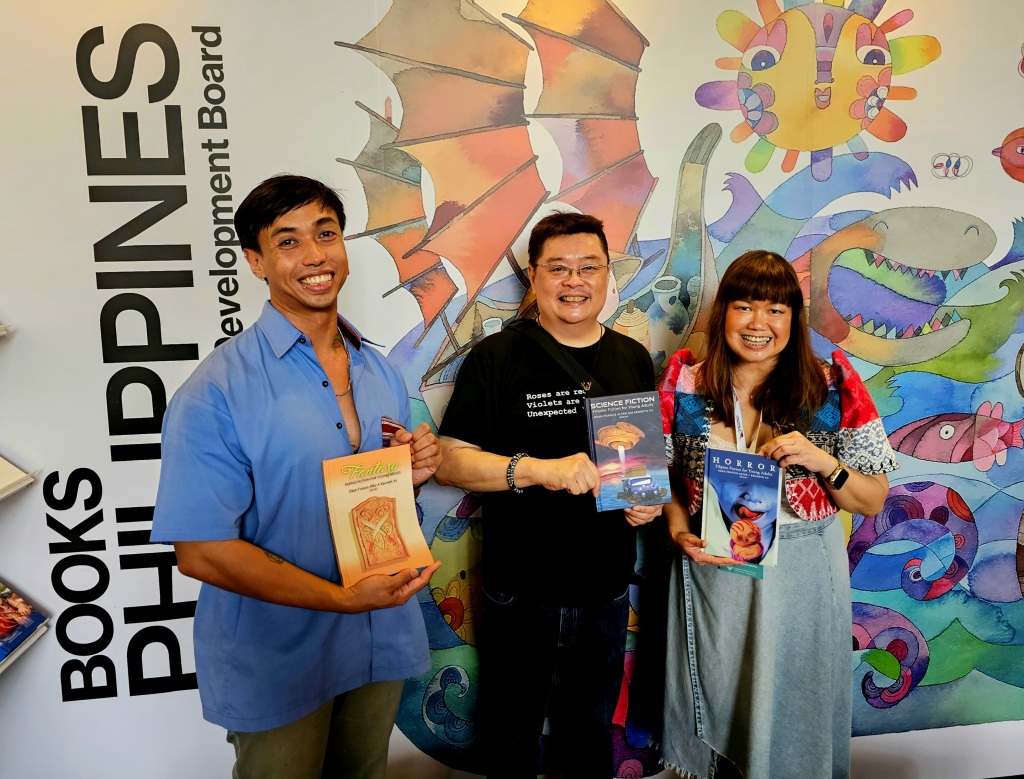
Met up with Filipino speculative fiction writer Joel Donato “Kupkeyk” Ching Jacob for lunch and attended his very interesting and informative talk “Locust Wings Take Flight: A Session on Character Creation” at the 15th Asian Festival of Children’s Content. With his permission, I incorporated his section on randomization in my lecture on writing Interactive Fiction at MOE’s Creative Arts Program the following week. BTW, I was really surprised to see copies of Science Fiction: Filipino Fiction for Young Adults (eds. Dean Francis Alfar and Kenneth G. Yu) at the Philippines’ country booth. I have a story in that anthology.
Lunch at a noodle bar in Bugis.
Kupkeyk talking about his wonderful YA book “Wing of the Locus” and it’s sequel, “Orphan Prince”.
Kupkeyk, myself and the lovely Claire Bettita de Guzman showing off a trio of Filipino speculative fiction books for young adults. I have a story in the science fiction volume that I am holding.
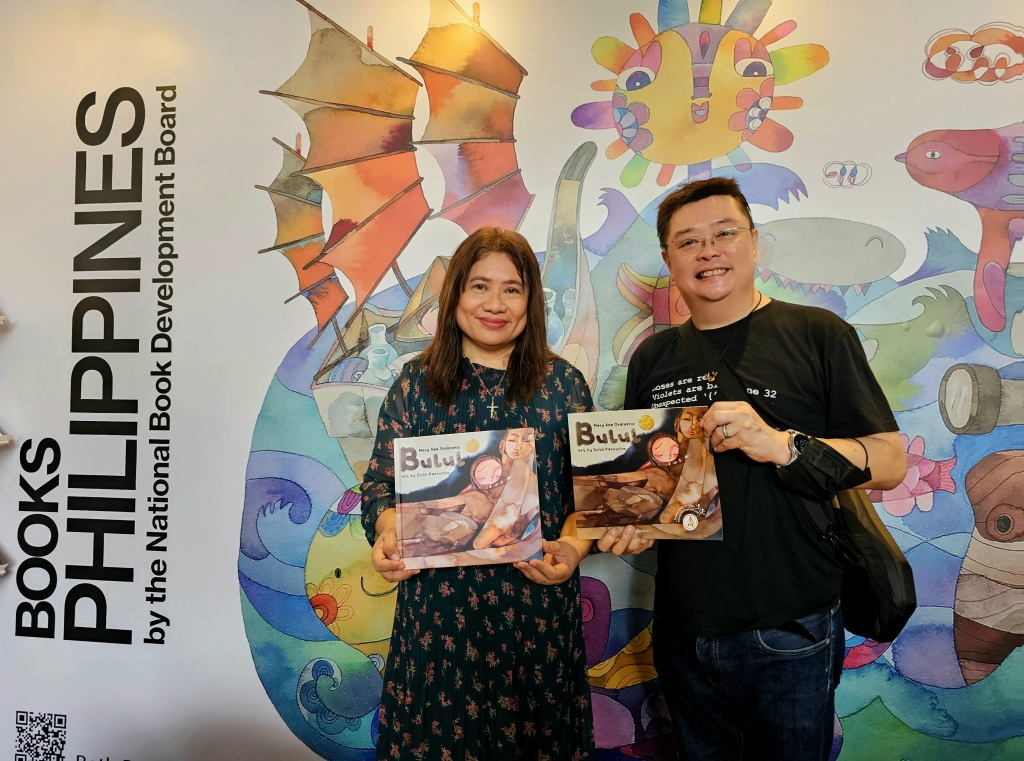
With Mary Ann Ordinario and her award-winning book, Bulol.
This workshop is for writers passionate about Asian science fiction and working towards publication in the genre. After a brief survey of SF written by Asians in Asia and the diaspora, I’ll discuss the nuts and bolts of craft including pacing, structure, and revision, as well as diving into topics of particular importance to science fiction authors, such as how to do research for authenticity, worldbuilding, incorporating scientific concepts and advanced technology and how to do revisions. Lastly, I’ll talk about the publishing process and the current science fiction market for short, medium, and long form fiction. The goal is for you to leave the workshop energized with a plan for writing and submitting your work.
Reading and Writing Asian Science Fiction by Victor Fernando R. Ocampo, in partnership with the Singapore Book Council Date: 14 October 2023 Time: 10am to 1pm Place: SBC Training Room 90 Goodman Road BLK E, #03-32 Cost: SGD$60; Register here
Science Fiction written by Asians living in Asia or in the diaspora, are enjoying a renaissance with authors like Cixin Liu, Hao Jingfang, R.F. Kuang and Yoon Ha Lee (among many others)frequently on the top of many best seller lists. As a writer passionate about speculative fiction, how do you create fiction that doeesn’t fall back on the tropes of exocticism and techno-orientalism? This workshop is an introduction to the exiting world of Science Fiction written in Asia. It also aims to help you develop stories that utilize your own lived experience to build your own vision of the future instead of being the futuristic “other” for Western (White/CIShet) audiences.
Objectives:
Understand what exactly is Science Fiction and what makes up the genre.
Learn the elements of what makes a good short story
I firmly believe that the only way to grow Southeast Asian Speculative Fiction is to create a new center of literature in the region, away from the Anglo-US sphere of influence. Perhaps Web 3.0 can help build a decentralized infrastructure for regional writers and artists, while providing a means to fairly compensate them for their work.
Watch this space for future announcements!
This article first appeared on my channel on Medium last 17 April 2023.
The advent of Web 3.0 is a game-changer, much like the discovery of the internet in 1996. It offers exciting opportunities for writers, publishers, editors, and readers, not the least of which is the potential for developing new hybrid art and writing forms that bring a new mode of transmediality and intermediality. Unfortunately, making sense of how it will revolutionize the way we write, publish, and consume written content has been mostly buried in hype, disinformation, and hard-to-understand jargon.
Web 3.0: A Brief Introduction
Web 3.0 is the next iteration of the internet, characterized by decentralization, collaboration, and immutability of content. It is built on top of an electronic ledger called a “blockchain,” which enables a decentralized internet that is not controlled by big tech companies, but owned and governed by its users. It is essentially the democratization of the publishing industry.
Web 1.0 involved desktops connected to the internet. Web 2.0 was centred on mobile phones and apps, including social media apps that allowed us to leave comments on content. Web 3.0 takes it a step further by enabling writers to publish their work directly on the blockchain, where it is permanently stored and can be accessed by any reader with an internet connection and a mobile wallet.
Smart contracts ensure that authors earn crypto rewards for contributing to the network based on the quality of their content and the engagement it receives. Decentralized platforms like Steemit and Hive allow writers to publish their work without intermediaries such as publishers or literary agents. This will force traditional publishing models to evolve and present both opportunities and challenges for new revenue streams.
Collaborative Writing Platforms
Web 3.0 also enables the development of collaborative writing platforms that can allow multiple authors, editors, and even readers to contribute to a single work. For instance, Textile can be used as a decentralized platform that enables writers to collaborate on a single novel. Each writer’s contribution is recorded on the blockchain to ensure that all contributors receive proper attribution, and the final work is transparent and tamper-proof.
Blockchain and Writing
Blockchain technology enables a new breed of hybrid textual artworks that are limited only by the authors’ imagination. Kalen Iwamoto is a Japanese-Canadian conceptual crypto writer and artist who converts blockchain processes into rules for writing and inserts poetry in web3 spaces (e.g., her “Few Understand” series[1]). On the publishing side, blockchain technology can be used to authenticate original work, manage royalties, and prevent plagiarism. This technology also offers an unprecedented level of security and trust, ensuring that writers receive proper credit for their work and are paid fairly for their contributions.
NFTs and Literature
Non-fungible tokens (NFTs) have become increasingly popular in the art world, but they also have potential use cases in writing and the publishing industry. NFTs can be used to monetize literature and create new revenue streams for writers. There are already various NFT marketplaces that already allow you to mint your own poem as an NFT[2]. An eBook can be minted as an NFT, providing digital proof of ownership (or at least access rights, depending on the jurisdiction) that cannot be erased or rescinded by an Apple or Amazon. However, it’s important to note that NFTs aren’t the art or content themselves, it’s more accurate to say they are simply the digital certificates of ownership.
A note on Sustainability
This has been an unfortunate misconception. Not only does a Web 3.0 approach mitigate carbon emissions, it also creates a whole new world of privacy and security by design that cuts down on the need for even more physical infrastructure to support the tens of billions of attachments sent around the world every day.
The Future of Writing and Publishing?
The impact of Web 3.0 on writing and publishing is potentially far-reaching. It is crucial for writers, publishers, and readers to understand and adapt to this change. Web 3.0 offers a new level of transparency, security, and trust, making it a powerful tool for writers, publishers, and readers. It is up to us to embrace it and make the most of it.
This review was actually posted 5 years ago. I had meant to RT it but for some reason, it got buried under all my other work. I am rectifying this grievous error now.
Thank you so much to Rachel’s Now Reading for your kind words. Please subscribe to her page to get book reviews on a wonderfully eclectic range of reading material.
“This is a book review of Victor Fernando R. Ocampo’s The Infinite Library and Other Stories. It’s a book containing 17 speculative fiction short stories somewhat linked together to make a whole.
If you’re a sci-fi fan, this is definitely the book for you. The presence of queer elements helped as I always love an inclusive book. I thoroughly enjoyed reading this collection and hope you will too!”
Here’s another teaser from my chapter of Mapping New Stars: A Sourcebook on Philippine Speculative Fiction (Editors: Gabriela Lee and Anna Felicia Sanchez, UP Press pre-publication) which was entitled “The Roots of Speculative Fiction in the Philippines” (you can also read the chapter intro here). For this section, I tried to identify the earliest known Filipino works that could be reasonably argued as Fantasy or Proto-Fantasy, but excluding Folk Literature.
Hope you find this interesting:
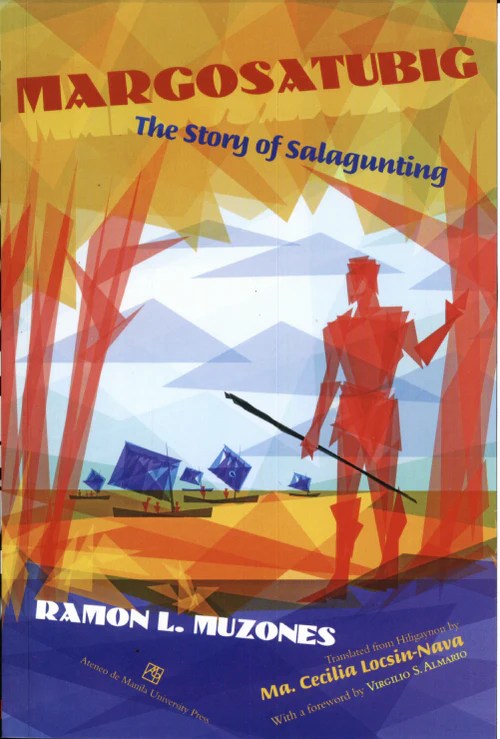
One of the earliest novels that could be characterized as proto-fantasy fiction is Ramon L. Muzones’ Margosatubig: Maragtás ni Salagunting (“The Land of Margosatubig: The History of the Hero Salagunting”) written in Hiligaynon from 1946.This is the cover of the English translation by Ma. Cecilia Y. Locsin-Nava (Ateneo de Manila University Press, 2012).
Navigating the genre of fantasy can sometimes be difficult and confusing as “fantasy” is not a single definite category but rather a cohesion of many diverse, often wildly different, sub-genres. Wikipedia defines “fantasy” as “a genre of speculative fiction set in a fictional universe, often inspired by real world myth and folklore[1]”.
Fantasy proper takes place in a world other than our own (second world fantasy), whereas the sub-genre of magical realism (also known as magical realism or marvelous realism) focuses entirely on an ordinary “real” world where everything is normal, “except for one or two elements that go beyond the realm of possibility as we know it[2]”. To date there are at least 58 named sub-genres of fantasy[3] including urban fantasy, Christian fantasy, dark fantasy, epic fantasy, mythic fantasy and vampire fantasy, just to name a few.
In the Philippines the roots of the fantasy genre begin in folklore – particularly in local tribal myths and legends, as well as in pre-Hispanic ethno-epics of which over 20 oral narratives have been recorded and translated (many more remain to be transcribed and/or translated – Palawan alone has sixty-three)[4]. It should be noted that while the natives of what would be eventually named las Islas Filipinos had little by way of books in codex form, the inland tribes and early maritime polities in the archipelago possessed a remarkable level of literacy and a strong literary tradition[5].
Myths and legends still figure prominently in modern speculative fiction works, albeit in reimagined or subverted forms, such as the graphic novel The Mythology Class by Arnold Arre (Quezon City: Alamat Comics,1999).
Epics (in the Philippines we speak of ethno-epics[6]) are considered the most direct ancestor of the fantasy tale. These long stories essentially consist of an oral narration of the adventures and trials of a revered folk hero. Sadly, as important as they are to Filipino culture, they have been less of an influence on modern speculative fiction compared to indigenous myths and legends. One of the few to have any impact was Biag ni Lam-Ang which is pre-colonial in origin.
Biag ni Lam-Ang (“Life of Lam-Ang”), tells the story of his extraordinary birth, his various quests aided by magical animal companions, as well as his death and resurrection. It became the subject of a metrical romance in the early 20th century, as well as various comic book adaptations in the 1970s, a movie, an animated film and even a musical theatre production.
Lam-Ang, from “Kagitingan at Pag-asa” by Crisanto Aquino in the CCP Encyclopedia of Philippine Art: Philippine Literature, Volume 9 (Cultural Center of the Philippines, 1994)
Let’s Start with (Philippine) Metrical Romance
The most popular genre of fiction during the 18th and 19th centuries was the metrical romance or chivalric romance, a type of narrative poem which in Europe developed from traditional myths and fables and was typically centered on courtly love, knights, and chivalric deeds. This genre wholeheartedly embraced fantastical elements and was a forerunner of the modern fantasy genre.
In the Philippines, metrical romance in vernacular languages (particularly Tagalog) took on two forms: the awit (a poetic narrative verse set in dodecasyllabic quatrains) and the korido (a poetic verse narrative set in octosyllabic quatrains). Like the epics that preceded them, these tales of chivalry were made to be sung and chanted.
Numerous works in Tagalog (around 200 titles were known to have been published[7]), Bicolano, Ilonggo, Kapampangan, Ilocano and the Pangasinan language were written during this period. Interestingly, while metrical romances are not speculative fiction per se, there has been no other time in Philippine history where fantasy-adjacent genre stories were the most accepted and feted literary works.
[4] Eugenio, Damiana L., “Introduction: The Philippine Folk Epic”, Philippine Folk Literature: The Epics (Quezon City: University of the Philippines Press, 2001), p. xi
[5] Jesuit friar Pedro Chirino notes, ‘All islanders are much given to reading and writing, and there is hardly a man and much less a woman, who does not read and write in the letters used in the island of Manila They used to write on reeds and palm-leaves, using as pen an iron point’. However, writing was used mainly for the exchange of letters. Religion, government, and literature were founded on oral tradition. In Chirino, Pedro, Relacion de las Islas Filipinas (Rome: Esteban Paulino, 1604) as translated and reproduced in Blair, Emma Helen and Robertson, James Alexander, The Philippine Islands, 1493-1898: Volume XII, 1601-1604 (Cleveland: Arthur H. Clark Company, 1904), p. 169
[6] As opposed to national epics like Germany’s Niebelunginlied, ethno-epics are “histories” of ethnic groups or small maritime polities that consider themselves “nations”. As per David-Maramba, Asuncion, Early Philippine Literature: From Ancient Times to 1940, (Mandaluyong: National Bookstore, 1971), p. 21. See also Godinez-Ortega, Christine, “The Literary Forms in Philippine Literature”, GOV PH, https://ncca.gov.ph/about-ncca-3/subcommissions/subcommission-on-the-arts-sca/literary-arts/the-literary-forms-in-philippine-literature/, (accessed 15 November 2020).
[7] Jurilla, Patricia May Bantug “Tagalog Bestsellers and the History of the Book in the Philippines”, doctoral thesis submitted to the School of Oriental and African Studies, University of London, 30 August 2006 p. 52
The Mythology Class by Arnold Arre. Originally published by the author in four issues in 1999, it was collected into a special edition by Anino Comics in September 2005 and Nautilus Comics in 2014.
A.I. generated art has been around for years. But tools released this year like DALL-E 2, Midjourney and Stable Diffusion — have made it possible for visual-art challenged people like myself to create fairly complex, abstract or photorealistic works simply by typing a few words into a text box.
These are my first attempts to illustrate some of my stories using Midjourney AI. Not incredible but not to shabby either. I could actually use some of these as e-book covers.
However, I am still on the fence about the ethics of A.I.-generated art. Are they a real emergent art form or a high-tech form of plagiarism? WDYT?
“Blessed are the Hungry” – this one came out the best. Funny how the rendered image looks like my youngest daughter.
“I ducked out of sight as soon as I saw the wolf-like mecha, shrouding my lantern with my shirt. Frightful as they were, I was mesmerized by their strange beauty. In the half-light of the Holosonic, their liquid-armor bodies shimmered purple, vermillion and bronze. I imagined these to be the colors of a sun that I had never seen, the burial clothes of a mother-star that we had abandoned so long ago.”
“Infinite Degrees of Freedom” – the blurry shape in the background is Midjourney unable to render a mythical sigbin monster in a spaceship corridor. Why does the kid from my story look like a young Rodrigo Duterte?
“From out of nowhere, Deo smelled an immensely foul odor, a rotting stench filled with the smell of death. A shape coalesced from the blackness, swiftly moving, gibbering, and utterly horrible. A sigben, a vicious half-dog/half-lizard chimera from ancient Philippine Myth had come for him. The impossible monster blocked his path and let loose a frightening roar-bark loud as a thunder clap.”
“Mene, Thecel, Pares” – My account expired before I could redo this with a steampunk Berlin in the background. The protagonist, Joseph Mercado (a fictionalized Jose Rizal) looks a bit cross-eyed.
“Joseph wished he didn’t have to remove his mask. Everywhere he went, people stared at him. Without his mask’s protection, the city’s xenophobic populace would peer from windows or point as he walked past whispering “fremde, außerirdische, ausländer, Asiaten, Japaner, Chinesischer Mann, Korean Mann” –- anything but his own ethnicity.”
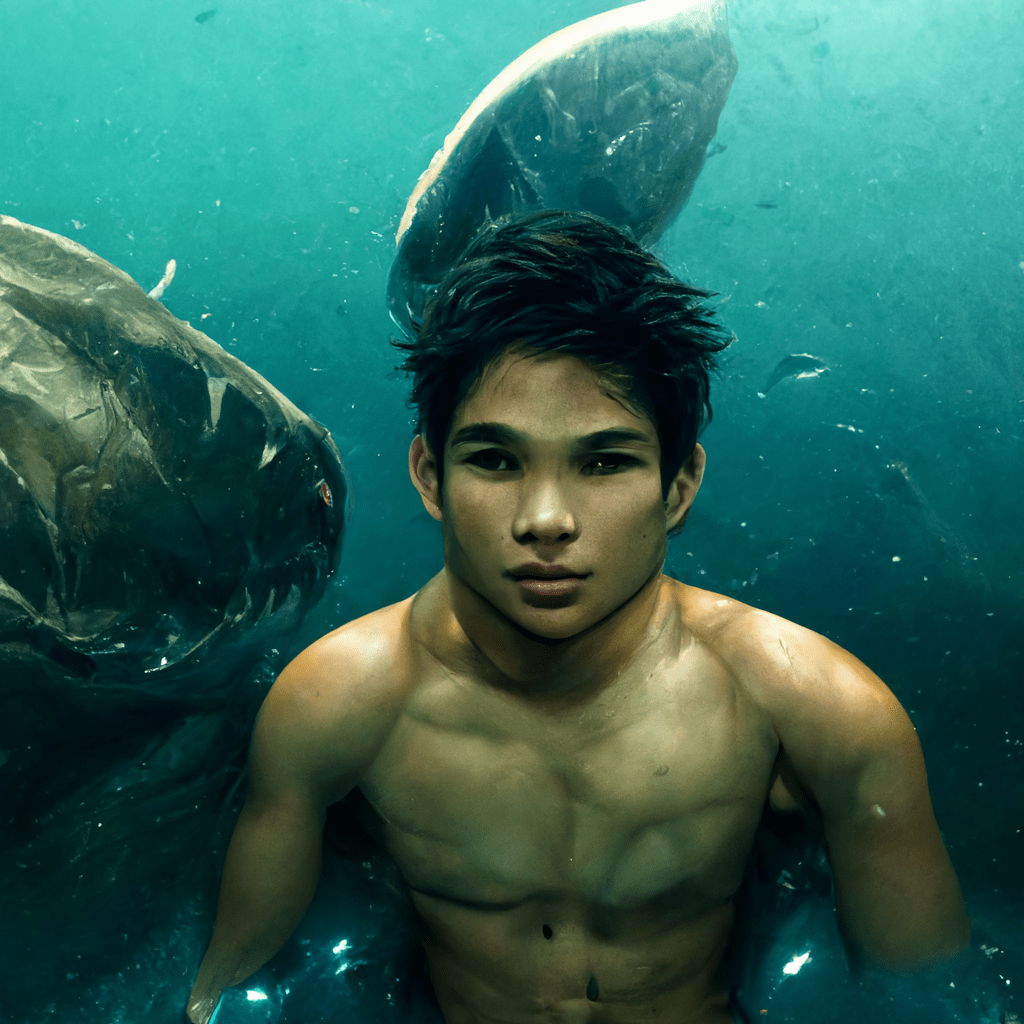
“Carry That Weight” – This is supposed to be the older brother, Berto. The two blobs in the background are supposed to be megamouth sharks. Also, the boy’s hair shouldn’t look like that underwater. Must be industrial-strength aquanet.
“The smaller boy watched as his brother fished out a pair of smart goggles from his shorts pocket and clipped his phone to his wristband. Berto’s body was dark and tightly muscled. He seemed naked save for the skintight nanotech body suit that kept his body warm and protected it from the sun’s radiation.“
Reading-Dialogue across the Sea between Get Luckier Sg/Phil writers
This Poetry Festival Singapore will take place from July 29 to August 10 this year in various locations across the island. Please join us this 30 July for a special event “Reading-Dialogue across the Sea” between Get Luckier Sg/Phil authors, with Singapore-based writers Paul Jerusalem, Migs Bravo-Dutt, Victor Ocampo, Reah Maac, Cathy Candano and Filipino poets Wilson Lee Flores, Wendell Capili, Jo Em Antonio, Cristina Montes, Mariela Lansang with spoken word poet LKN as host (and Cathy Candano as technology expert). The recording will be done from 8pm onwards. Stay tuned for the announcement of the online broadcast.
Get Luckier – An Anthology of Philippine and Singapore Writings II (Editors Migs Bravo Dutt, Claire Betita de Guzman, Aaron Lee Soon Yong and Eric Tinsay Valles) is the sequel to the much-loved original Get Lucky from six years ago. It features writing that illustrate how technology, the pandemic and other current events have impacted the fellowship between Singaporeans and Filipinos.
The landmark anthology Fish Eats Lion: New Singaporean Speculative Fiction collected the best original speculative fiction written in Singapore in or around 2012. It was the first local anthology that treated the literature of the fantastic as bona fide literary work, instead of simply just genre. Edited by Jason Erik Lundberg, this book included stories by Ng Yi-Sheng, Neon Yang, Daryl Yam and Shelly Bryant, who would all become leading lights in the APAC Spec Fic sphere, as well as works by mainstream fictionists who were not generally known for fantastical writing such as Grace Chia, Dave Chua, Noelle de Jesus, Isa Kamari, and Cyril Wong.
It’s been ten years since the original FEL and Jason has commissioned a follow-up anthology. I am very happy to be part of both books but it’s also a bit of a shock to realize that I’ve been getting published for so long. In my mind I am still a new writer struggling to get stories written and published (when I am not doing my day-job or house work, that is).
Congratulations to our evergreen editor Jason Erik Lundberg and to everyone on the new antho’s TOC. I can’t wait to read these new stories!








 The Infinite Library and Other Stories