Artificial Intelligence. Web 3.0. Augmented and Virtual Reality. what role do emerging and speculative technologies play in the arts? In this session of Beyond Text, we explore how contemporary art, speculative design, and world-building are used for storytelling. We also examine the portrayal of these speculative technologies in fiction.
Please join our panel as they discuss these new technologies, their benefits, dangers, and misconceptions in the context of storytelling and the arts. Brought to you by GoLibrary | National Library Board, Singapore.
Thank you to the Ministry of Education’s Gifted Education Branch for inviting me once again to hold a Creative Arts Program workshop on adding interactivity and cross-platform functionality to your writing. I absolutely love teaching these sessions (and it seems that the feeling was mutual as students were mobbing me for advice long after the actual class was over).
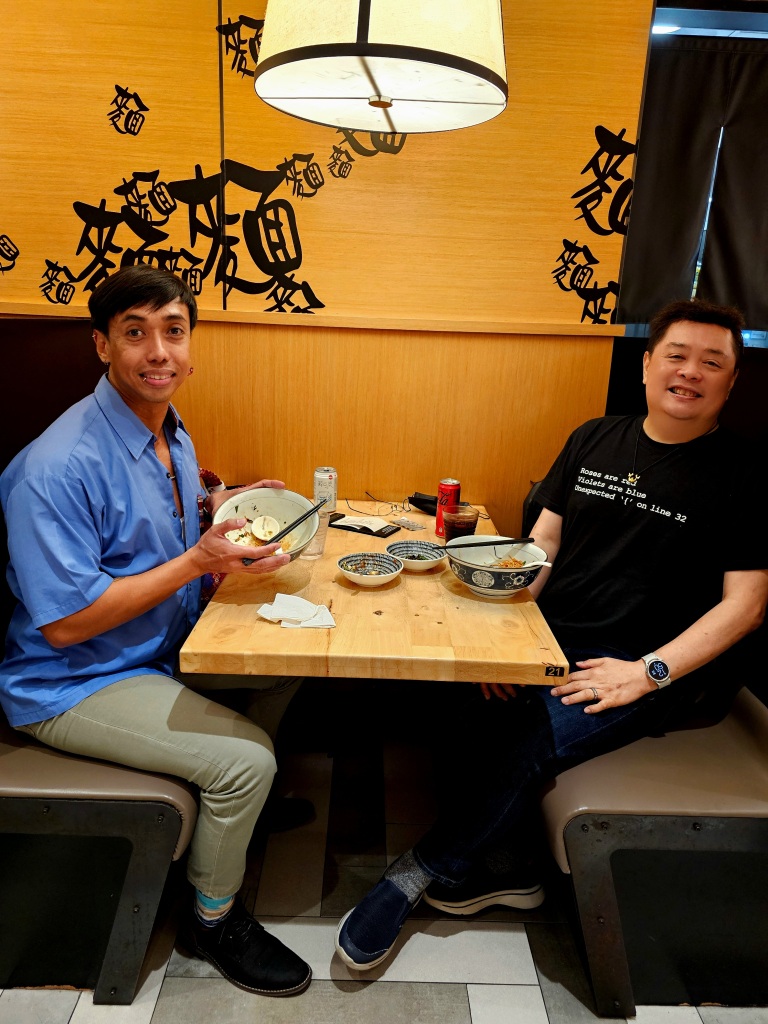
Met up with Filipino speculative fiction writer Joel Donato “Kupkeyk” Ching Jacob for lunch and attended his very interesting and informative talk “Locust Wings Take Flight: A Session on Character Creation” at the 15th Asian Festival of Children’s Content. With his permission, I incorporated his section on randomization in my lecture on writing Interactive Fiction at MOE’s Creative Arts Program the following week. BTW, I was really surprised to see copies of Science Fiction: Filipino Fiction for Young Adults (eds. Dean Francis Alfar and Kenneth G. Yu) at the Philippines’ country booth. I have a story in that anthology.
Lunch at a noodle bar in Bugis.
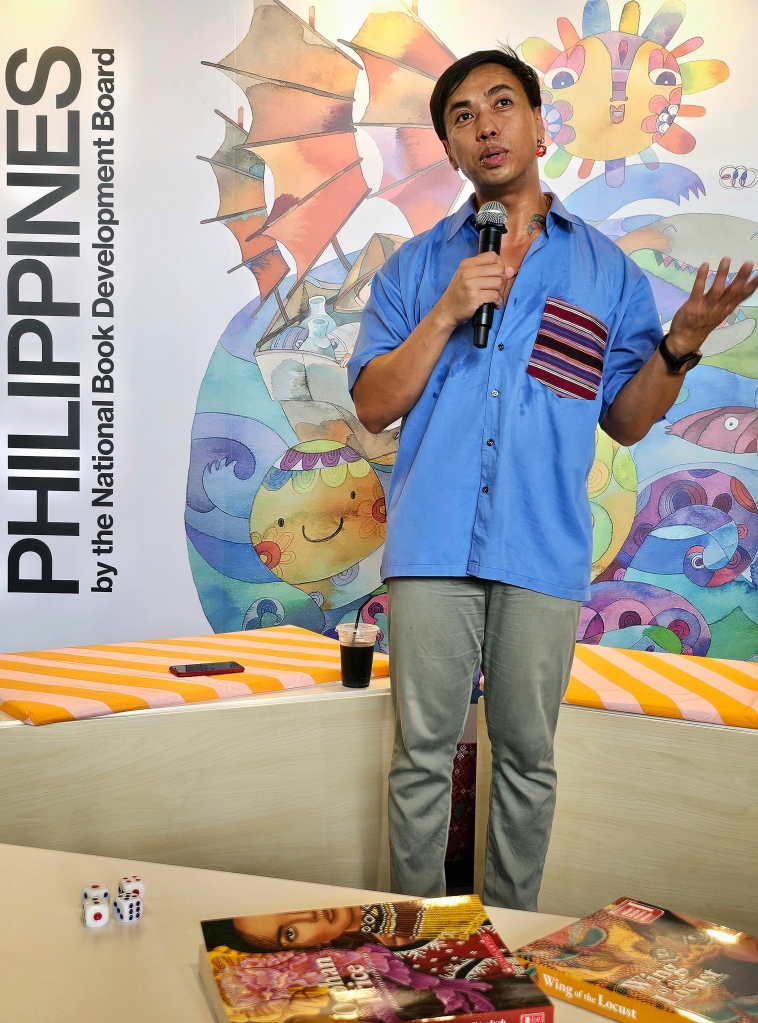
Kupkeyk talking about his wonderful YA book “Wing of the Locus” and it’s sequel, “Orphan Prince”.
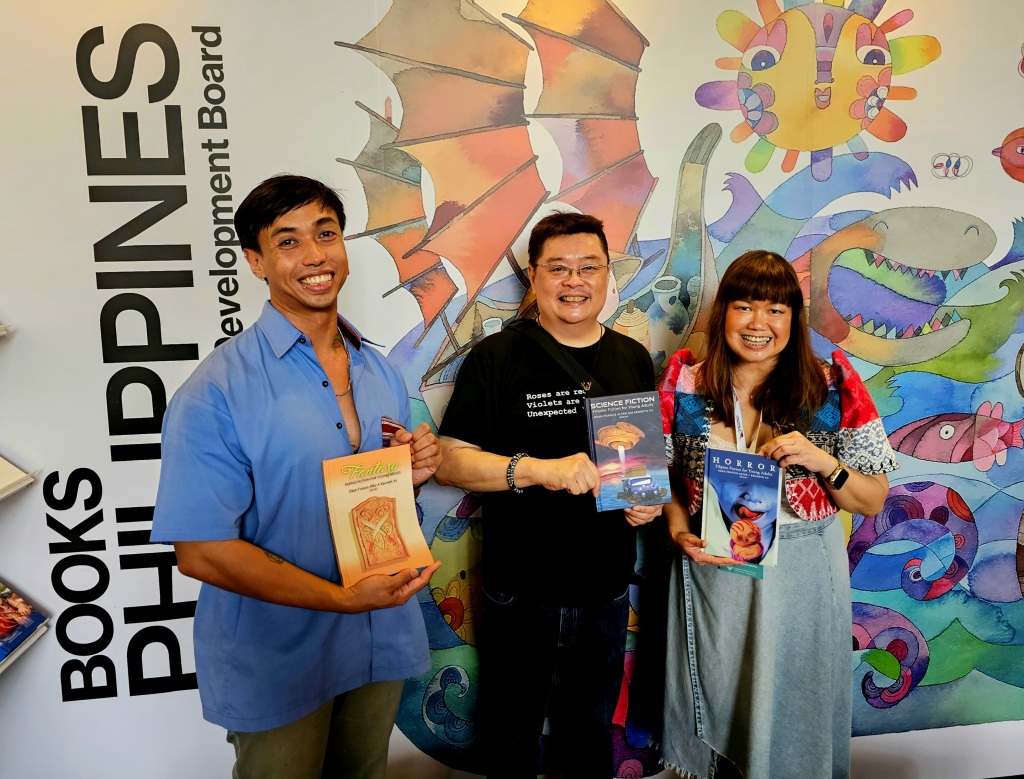
Kupkeyk, myself and the lovely Claire Bettita de Guzman showing off a trio of Filipino speculative fiction books for young adults. I have a story in the science fiction volume that I am holding.
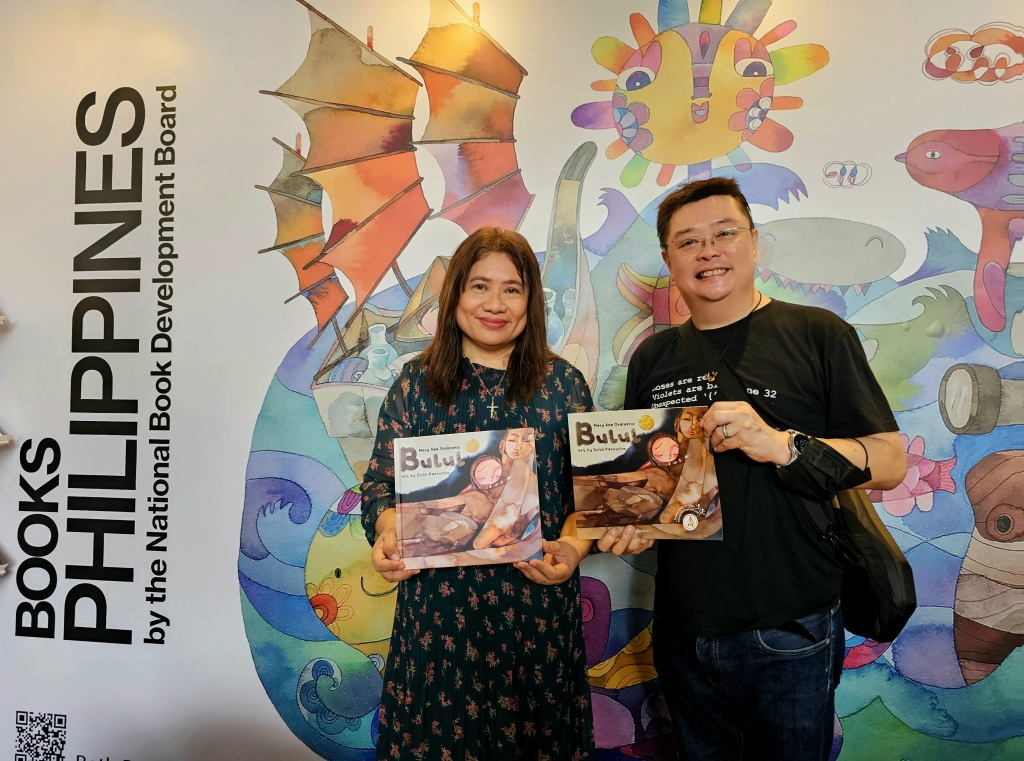
With Mary Ann Ordinario and her award-winning book, Bulol.
Frederick Pohl once said that Science Fiction wasn’t about technology but rather its human and societal implications – in other words, it wasn’t about cars but about traffic jams. This idea of using science fiction to describe and explore the implications of futuristic technologies and the social structures enabled by them was behind the project Cntrl+Alt+Delete by Nanyang Technological University, the Singapore government, and four speculative fiction writers (myself, Sarah Ang, Wen-yi Lee and Nuraliah Norasid).
Yesterday we got to talk about our SF stories and the cutting-edge technologies we wrote about at the Synergy Art x Tech Fringe Festival at the Figma Clubhouse organized by #Tusitala and #BeFantastic. Poet, technology enthusiast and civil servant Tse Hao Guang facilitated.
I had written 3 short stories: these include (1) a puppy love romance between two teens trapped in locked-in syndrome, involving AI, EEGs and Virtual reality technologies, (2) an extraordinary Singaporean triathlete and his obsession with enhancing his sports performance at any cost, involving advance prosthetics, and gene therapy, and lastly (3) a slightly gonzo tale about an alien invasion in Bukit Batok, with exploding birds, interdimensional travel, an autonomous vehicle full of hapless retirees in the most low-speed death ride ever. All three will become part of my second short story collection which I plan to finish by the end of this year.
If you are going going to the 2024 AWP (Association of Writers & Writing Programs) Conference & Bookfair in Kansas City, Missouri this February 7–10, don’t forget to get a copy of my book, The Infinite Library and Other Stories, as well as all these other great books by outstanding Asian authors!
The AWP Conference & Bookfair is the annual destination for writers, teachers, students, editors, and publishers of contemporary creative writing. It includes thousands of attendees, hundreds of events and bookfair exhibitors, and four days of essential literary conversation and celebration. The AWP Conference & Bookfair has always been a place of connection, reunion, and joy, and we are excited to see the writing community come together again in Kansas City, Missouri in 2024.
Nothing tests the strength of acceptance and belonging more than speculative universes where characters of no relation come together. Add unexpected life-changing adventures in stories, and you get a mishmash of misfits and reluctant heroes, forging unbreakable bonds. Three science fiction and fantasy writers muse on found families, unconventional relationships, and how we can find human connection in the most unlikely corners of existence.
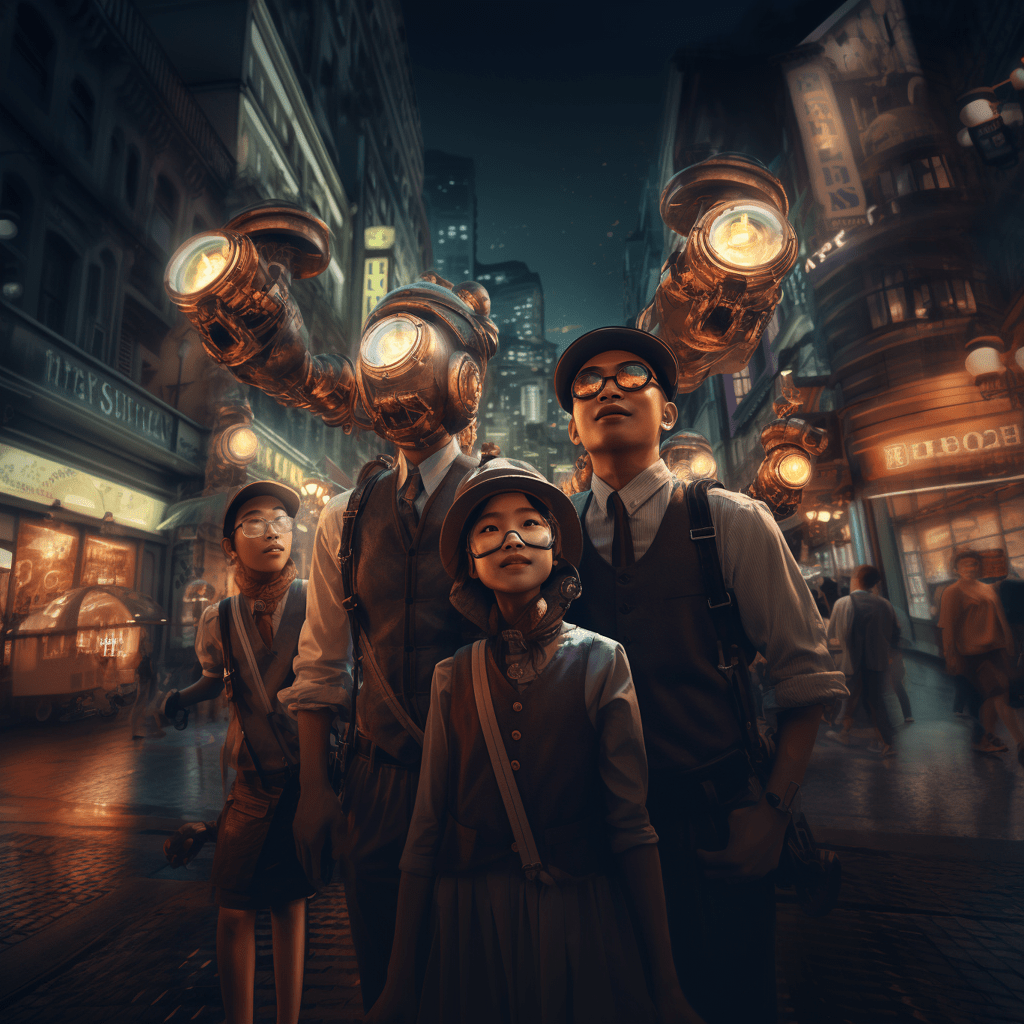
Steampunk and cyberpunk have been the OGs of their sci-fi subgenre, but it looks like there are some new kids in town! Taking a look at young ‘punks’ like dieselpunk, biopunk, and even… oceanpunk(?!), we unpack the ‘punk’ suffix and why it has spawned so many variations. Is it a fetishising of technology or a commentary on technocracies out of control? What kind of tensions do they invite with our past and future? What ties all these punks together and what new punks are being born?
This workshop is for writers passionate about Asian science fiction and working towards publication in the genre. After a brief survey of SF written by Asians in Asia and the diaspora, I’ll discuss the nuts and bolts of craft including pacing, structure, and revision, as well as diving into topics of particular importance to science fiction authors, such as how to do research for authenticity, worldbuilding, incorporating scientific concepts and advanced technology and how to do revisions. Lastly, I’ll talk about the publishing process and the current science fiction market for short, medium, and long form fiction. The goal is for you to leave the workshop energized with a plan for writing and submitting your work.
Reading and Writing Asian Science Fiction by Victor Fernando R. Ocampo, in partnership with the Singapore Book Council Date: 14 October 2023 Time: 10am to 1pm Place: SBC Training Room 90 Goodman Road BLK E, #03-32 Cost: SGD$60; Register here
Science Fiction written by Asians living in Asia or in the diaspora, are enjoying a renaissance with authors like Cixin Liu, Hao Jingfang, R.F. Kuang and Yoon Ha Lee (among many others)frequently on the top of many best seller lists. As a writer passionate about speculative fiction, how do you create fiction that doeesn’t fall back on the tropes of exocticism and techno-orientalism? This workshop is an introduction to the exiting world of Science Fiction written in Asia. It also aims to help you develop stories that utilize your own lived experience to build your own vision of the future instead of being the futuristic “other” for Western (White/CIShet) audiences.
Objectives:
Understand what exactly is Science Fiction and what makes up the genre.
Learn the elements of what makes a good short story
Not too long ago, the business of creativity was a uniquely human endeavor. However, with the arrival of generative AI, this has started to change. With how entrenched Artificial Intelligence has already become everywhere else in our lives (job automation, search engines, shopping recommendation engines, games, self-driving vehicles, etc.) this intrusion into the Arts was perhaps inevitable — even as various creative communities have tried their best to resist it.
However, I believe that the best response to this AI onslaught is not simply adopting an anti-technology stance, but rather to provide more education to fight disinformation and fear. The best way to defend the all-important human component of creativity is to understand AI’s accompanying threats and challenges — as well as to identify potential opportunities that this technology can bring.
Once we understand how it works and what is to change and how, we can be better prepared to use it where it can do the most good without stealing our work. Education also allows us to lobby for the right laws and regulations, and perhaps also for a future where the Arts include properly attributed and more nuanced human–machine collaborations (if we choose to allow it).
I was initially reluctant to be a part of Singapore Polytechnic’s AI Manga creating challenge, but I am glad that I did because I realized that it was an ideal platform to provide a comprehensive introduction on how to use AI tools like ChatGPT and Midjourney in creative work – particularly in ideation, editing and revision; as well as to discuss its merits, ethics, legality (How does it affect your copyright?) and dangers (potential plagiarism). It was also a great way to teach kids that automation by itself produces sub-par work (humans will always be important), and that the current buzz words like being “a master of prompt engineering” is useless in the long run because the of how fast technology changes (It’s much better to learn how to formulate problems instead.)
This workshop, held last 25 October, was designed to introduce generative AI and its applications in manga and comics creation. Participants delved into the world of AI-generated comics content (e.g. Cyberpunk Peach John by Rootport [Tokyo, Shinchosha; 2023] ) and learned how to leverage generative AI models to enhance their storytelling, character design, and visual elements. By the end of the course, students would have hopefully been armed with the knowledge and skills to use generative AI responsibly, and how not to feed the thieving devil that is automation from stealing their ideas.
AI has become such a contentious topic among artists and writers (- and with the way that late-stage capitalism has abused it so much for profit at our expense,, only rightly so). But at the end of the day, it’s really just another tool which we, as creatives, should at least be educated about in order to decide when and how to use it.
At the moment, there is too much hype, disinformation and fear. As creators in the 21st century, we should consider all the tools at our disposal to create our best work, while at the same time fighting for the rights of creative workers and the importance of the human component in Art for society’s common good.
Thank you again to Singapore Polytechnic’s Media, Arts & Design School, the River Valley Irregulars and the Difference Engine Comics publishing house for inviting me to be a part of this project.
Philippine Genre Stories is one of the foundational venues for publishing Filipino science fiction, fantasy, horror, and crime short stories. They are once more open for submissions so Filipino writers at home and overseas, now is your chance to get published!
Continuing as guest editor is the always awesome Mia Tijam, author of the 40th National Book Award Finalist for Short Fiction in English “Flowers for Thursday”, co-editor of Philippine Speculative Fiction Sampler, and editor for the Special Section for PWDs and PADs of the Cultural Center of the Philippines’ Literary Journal ANI 41: LAKBAY.
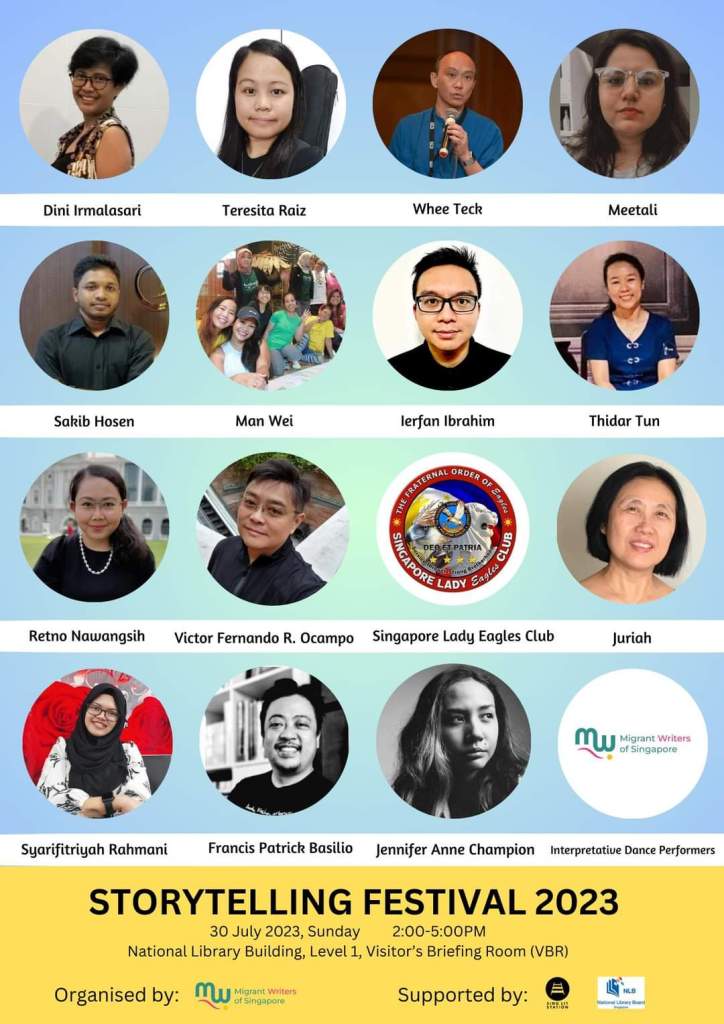
Thank you to everyone who came to the very well-attended 𝐒𝐓𝐎𝐑𝐘𝐓𝐄𝐋𝐋𝐈𝐍𝐆 𝐅𝐄𝐒𝐓𝐈𝐕𝐀𝐋, organized by Migrant Writers of Singapore and generously supported by Sing Lit Station and National Library Board, Singapore last Sunday 30, July 2023.
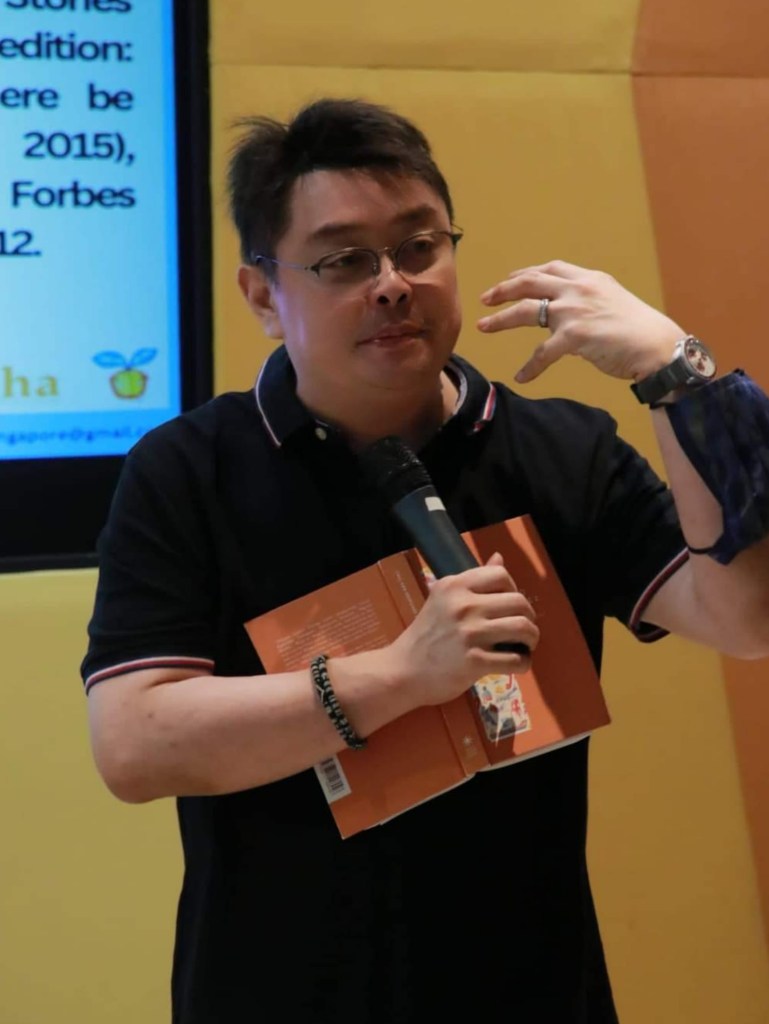
Thank you also to Jane Lyn Dupingay and the MWS team for inviting me to read my flash fiction piece “Buhay ay Langit sa Piling Mo” (“Life is Heaven in your Arms”) and its lovely companion piece “Beginning of Autumn” by the Chinese poet and migrant worker Zhang Haitao. The paired pieces were part of the second volume of Call and Response 2: A Singapore Migrant Anthology(Math Paper Press, 2021), edited by Zakir Hossain Khoran, Bhing Navato, Poh Yong Han and Joshua Ip.

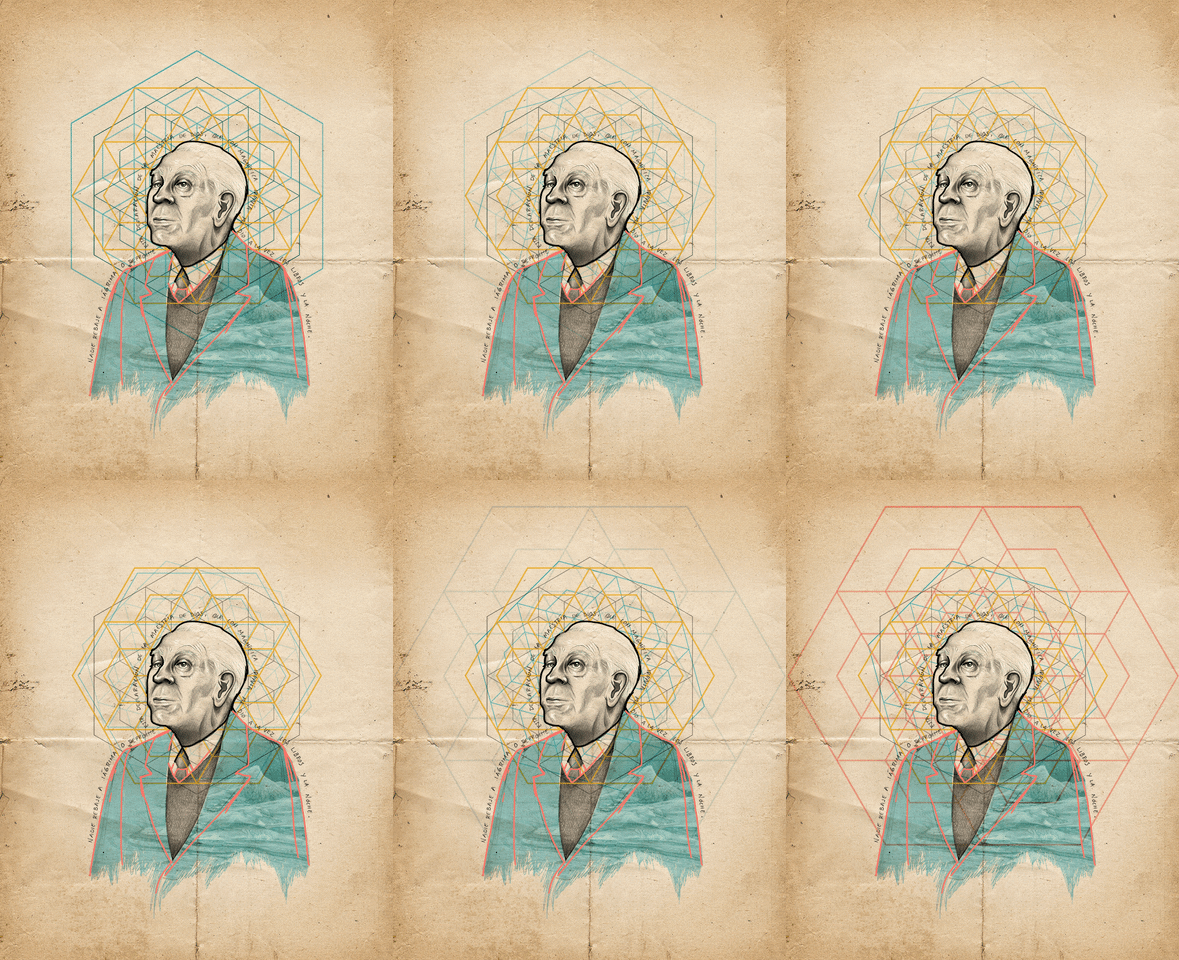






 The Infinite Library and Other Stories