Thank you to Kenneth Yu and Mia Tijam for giving my (sort of) science fiction fairytale “The Ocean Above her” a home in Philippine Genre Stories.
My wife and I both went through life-threatening illnesses over the last year, and consequently my writing productivity was very poor. I’m happy I managed to complete this story given how trying our circumstances were.
I had originally wanted to write a literal children’s fairy tale but I could not manage to keep the language simple enough for a pre-teen to understand without losing the heart of the story. Although this generation ship Sci-Fi story is no longer specifically written for kids, I hope I was able to capture that sense of wonder that children have when encountering something astonishing, as well as the bewilderment that comes when facing something as dark and painful as the death of someone they love.
I also wanted to challenge the notion that a far-future story had to be written in a cold, technobabble-filled manner. I wanted a future like the handwoven inabel blankets my grandmother used to buy for us when we were children – something warm, comforting and familiar.
My humble submission is PGS’ story for December, but it’s not a Christmas story. However if you want to read something about endings and beginnings, familial love, and the importance of remembering, please read The Ocean Above Her. If you like it, kindly leave me a comment or RT. Thank you!
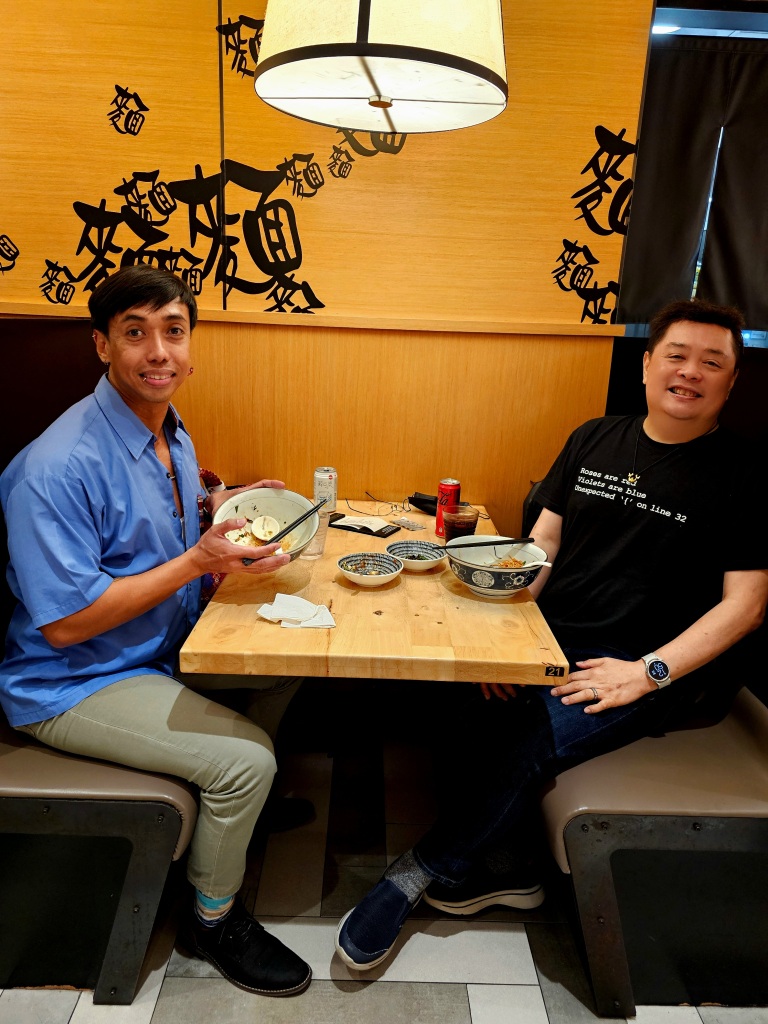
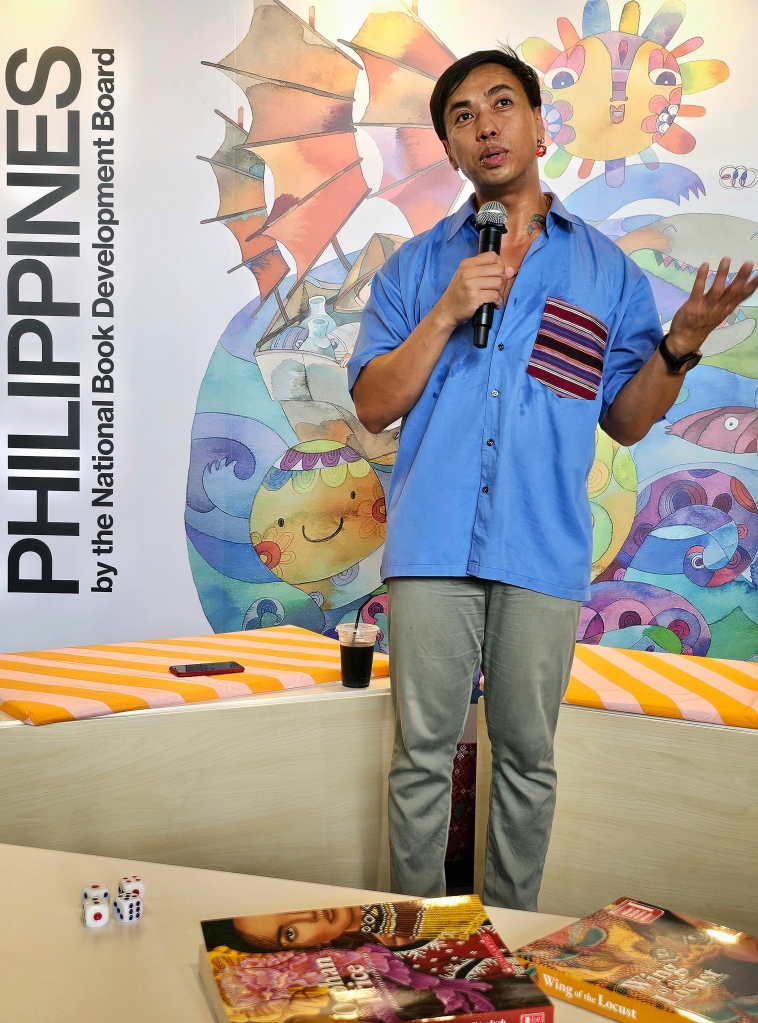
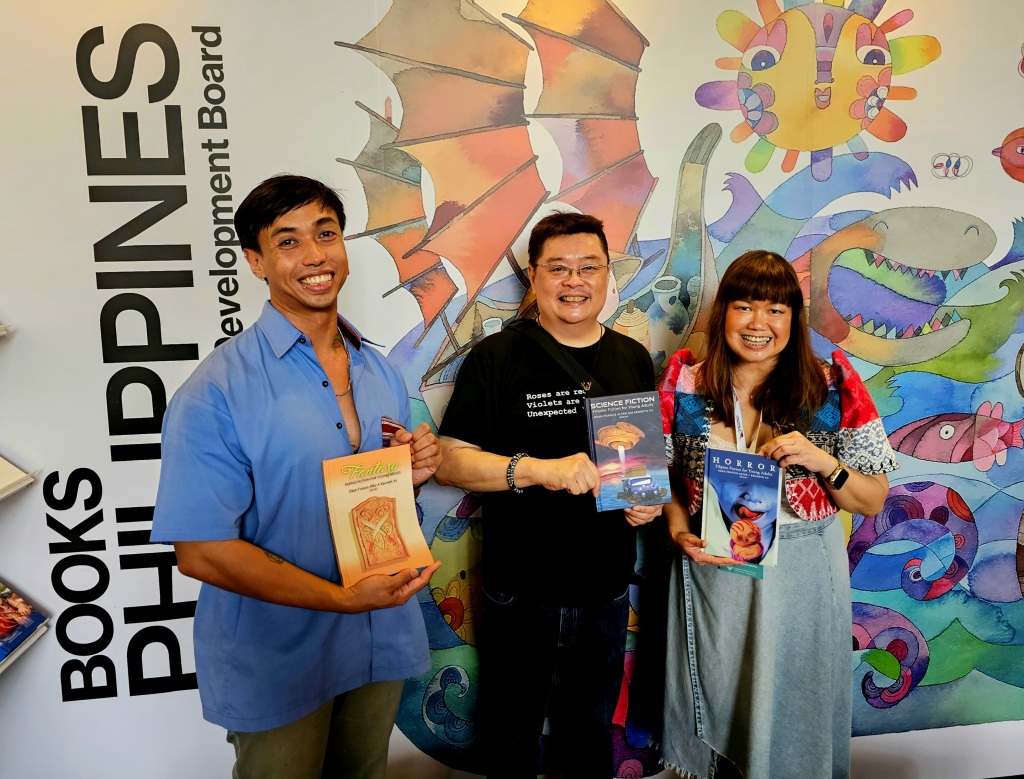
Met up with Filipino speculative fiction writer Joel Donato “Kupkeyk” Ching Jacob for lunch and attended his very interesting and informative talk “Locust Wings Take Flight: A Session on Character Creation” at the 15th Asian Festival of Children’s Content. With his permission, I incorporated his section on randomization in my lecture on writing Interactive Fiction at MOE’s Creative Arts Program the following week. BTW, I was really surprised to see copies of Science Fiction: Filipino Fiction for Young Adults (eds. Dean Francis Alfar and Kenneth G. Yu) at the Philippines’ country booth. I have a story in that anthology.
Lunch at a noodle bar in Bugis.
Kupkeyk talking about his wonderful YA book “Wing of the Locus” and it’s sequel, “Orphan Prince”.
Kupkeyk, myself and the lovely Claire Bettita de Guzman showing off a trio of Filipino speculative fiction books for young adults. I have a story in the science fiction volume that I am holding.
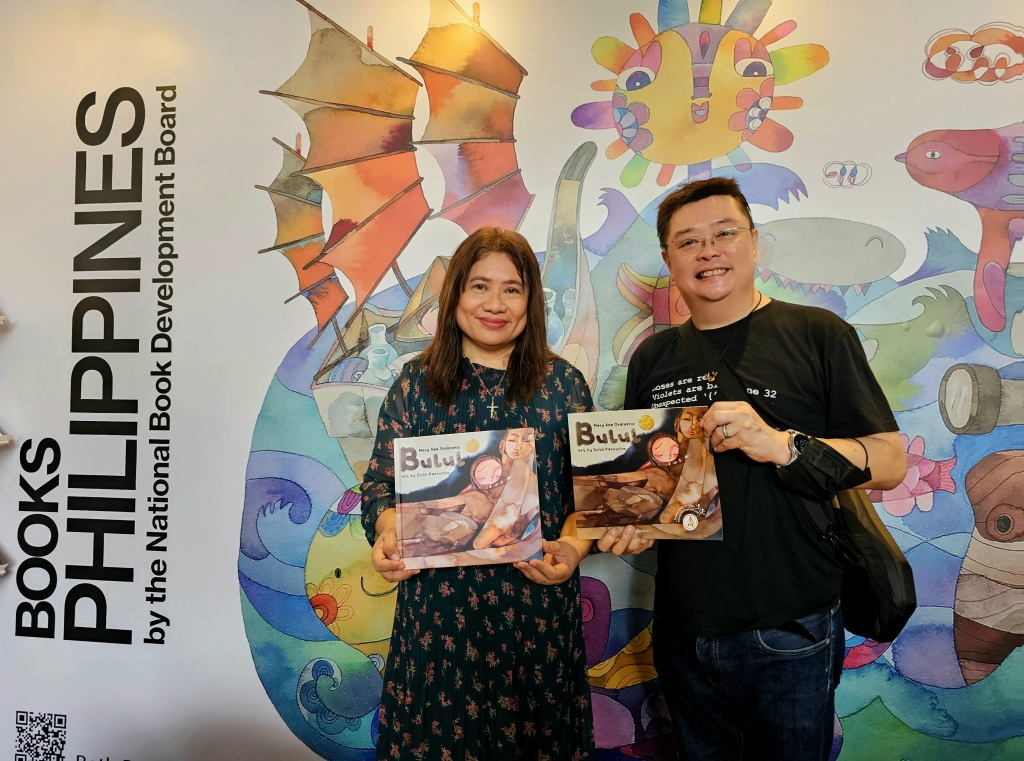
With Mary Ann Ordinario and her award-winning book, Bulol.
Philippine Genre Stories is one of the foundational venues for publishing Filipino science fiction, fantasy, horror, and crime short stories. They are once more open for submissions so Filipino writers at home and overseas, now is your chance to get published!
Continuing as guest editor is the always awesome Mia Tijam, author of the 40th National Book Award Finalist for Short Fiction in English “Flowers for Thursday”, co-editor of Philippine Speculative Fiction Sampler, and editor for the Special Section for PWDs and PADs of the Cultural Center of the Philippines’ Literary Journal ANI 41: LAKBAY.
This review was actually posted 5 years ago. I had meant to RT it but for some reason, it got buried under all my other work. I am rectifying this grievous error now.
Thank you so much to Rachel’s Now Reading for your kind words. Please subscribe to her page to get book reviews on a wonderfully eclectic range of reading material.
“This is a book review of Victor Fernando R. Ocampo’s The Infinite Library and Other Stories. It’s a book containing 17 speculative fiction short stories somewhat linked together to make a whole.
If you’re a sci-fi fan, this is definitely the book for you. The presence of queer elements helped as I always love an inclusive book. I thoroughly enjoyed reading this collection and hope you will too!”
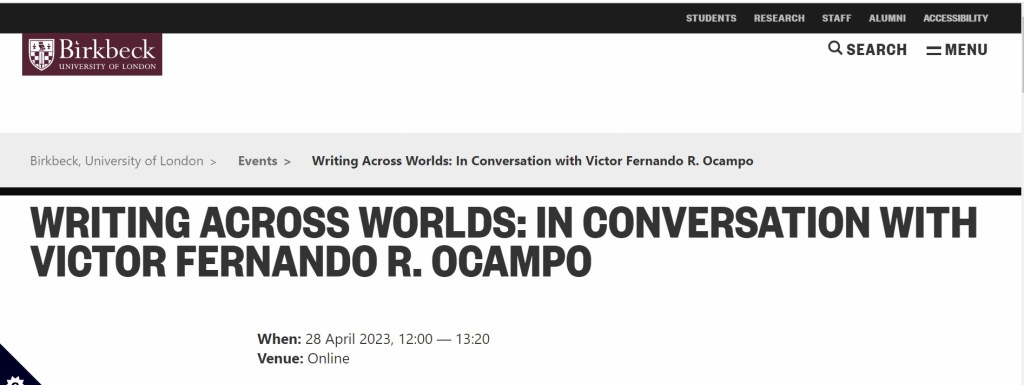
Thank you so much to London-based Malaysian editor, writer, and theatre practitioner Zhui Ning Chang for inviting me to be a guest speaker at Birkbeck, University of London’s Arts Week 2023 yesterday. We had a great conversation about the themes of liminality, displacement and death in my book The Infinite Library and Other Stories, as well as my writing process, and the state of speculative fiction in Southeast Asia today. Thank you also to the very lively audience for all the thoughtful questions.
As requested, here are the links to where it’s available in the UK – Bookshop.org and Amazon UK
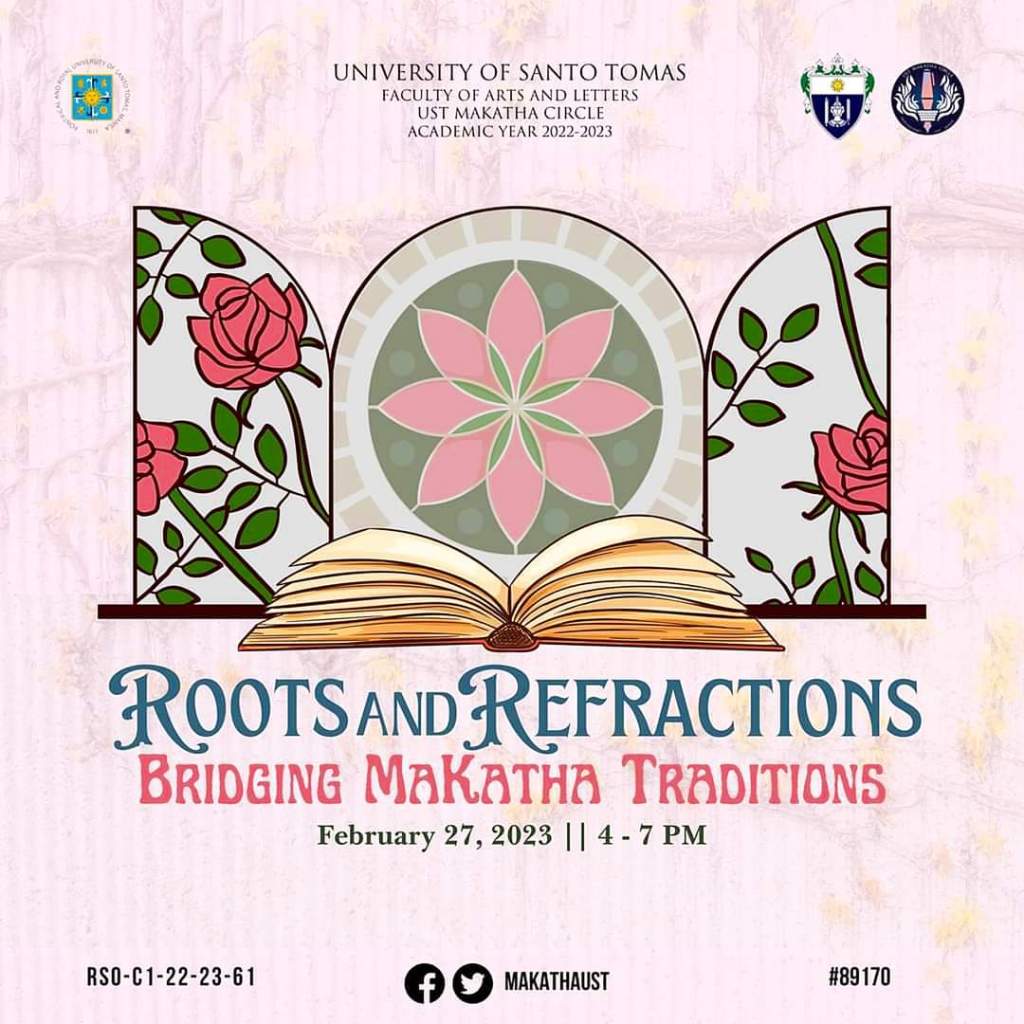
Thank you to the UST Faculty of Arts & Letters and the UST MaKatha Circle for inviting me to share my writing journey at their ” Roots & Refractions: Bridging MaKatha Traditions” event last 27 February. I really enjoyed interacting with so many young writers.
Keep reading what makes your heart sing. Fill yourself up with all the beauty that life throws your way. And keep writing — because young creatives like you are our best defense against all the terrible and ugly things darkening our reality. Once you realize what this world is worth, you will fight to defend it.
Write a new world for all of us…
#MaKaATIN
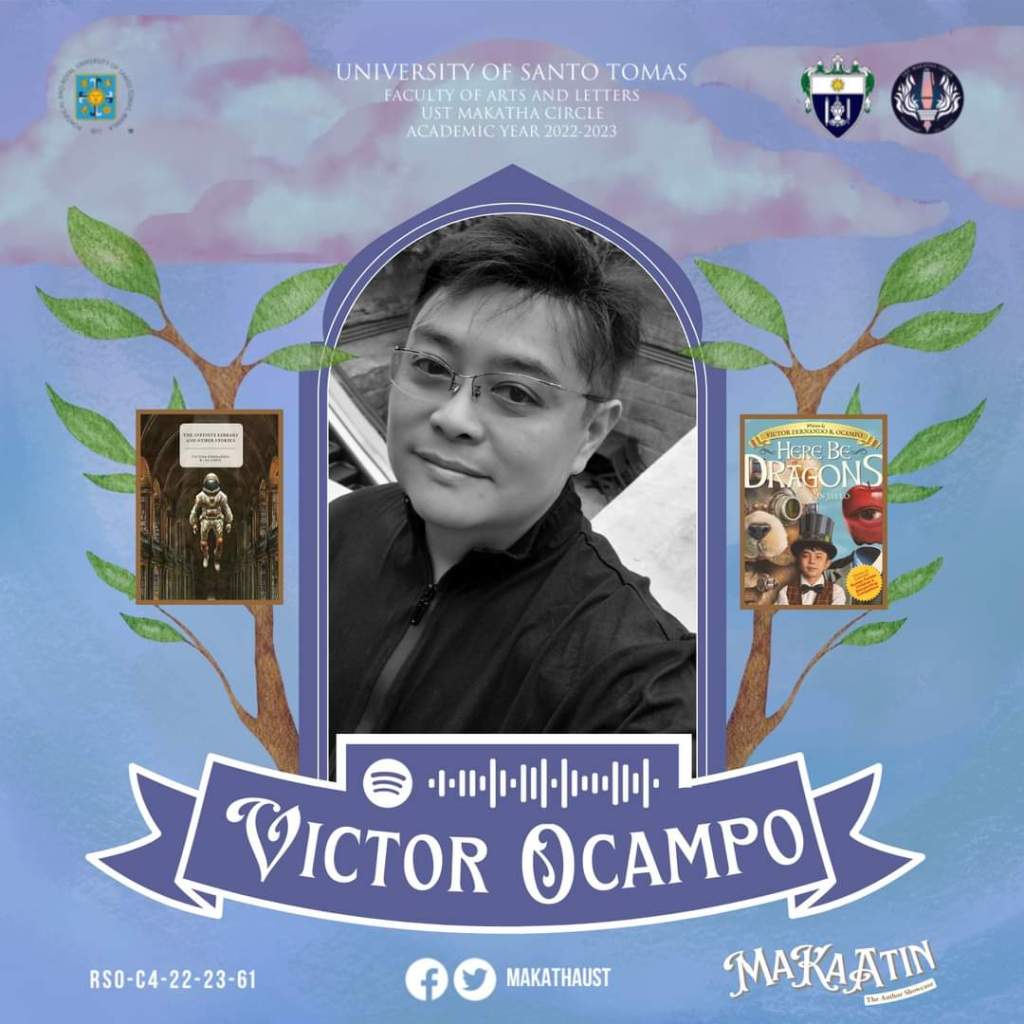
Up next, meet Victor Fernando R. Ocampo, a Filipino author of speculative and experimental fiction stories!
A fellow at the Milford Science Fiction Writers’ Conference in the UK and the Cinemalaya Ricky Lee Film Script Writing Workshop in the Philippines, he currently resides in Singapore where he was also a writer-in-residence at the Jalan Besar at Sing Lit Station. His works have been shortlisted for the International Rubery Book Award in 2018, and he won the Romeo Forbes Children’s Story Award in 2012.
Victor’s most recognized stories include:
THE INFINITE LIBRARY AND OTHER STORIES. Three Filipino siblings fighting an enemy that uses words as weapons, sigbin monsters in space, a banned children’s book hiding a secret that could save a doomed generation ship, a slow-motion disaster turning people into living math equations,?! Name it and this book surely has it. Grab this collection of stories that goes beyond what our mind deems possible and be carried away by all its mystical twists and turns.
Grab a copy:
HERE BE DRAGONS. Ever wished to have a map that would make life easier? Well,
Isabella met the perfect guy that makes a map of just about anything! Would she take the risk
“An Excerpt from the Philippine Journal of Archaeology (04 October, 1916)”, a Lovecraftian metafiction story told in footnotes, first appeared in Likhaan Journal 8 by the U.P. Institute of Creative Writing in December 2014. – https://journals.upd.edu.ph/index.php/lik/article/viewFile/5072/4577
“The Easiest Way to Solve a Problem” is a short story about adding the consciousness of expat Filipino PMET workers to a massive corporate AI in Singapore. It appeared last April, 2022 in the book Get Luckier: An Anthology of Philippine and Singapore Writings (Singapore: Squircle Line Press, 2022), edited by Migs Bravo Dutt, Claire Betita de Guzman, Aaron Lee Soon Yong, and Eric Tinsay Valles. – https://www.get-luckier-anthology.com/victor-fernando-r-ocampo
“I m d 1 in 10” , his experimental story inspired by Anicius Manlius Severinus Boëthius’ De Consolatione Philosophiae, first appeared in the July 2014 issue of The Future Fire (Editor: Djibril al-Ayad). It was written with Latin, L337, IM and SMS speak, emoticons and a Filipino argot called Jejemon. – http://futurefire.net/2014.30/fiction/imd1in10.html
Immerse yourselves in Victor Ocampo’s works with this playlist!
#MakaATIN
#MKC2223
#MakaTraditions
#GrowWithMKC
: Anjellyca Villamayor, and Roanne Aludino
: Chrystal Cariño, Lauren Ainella Tagle, and Sophia Mendoza
Here’s another teaser from my chapter of Mapping New Stars: A Sourcebook on Philippine Speculative Fiction (Editors: Gabriela Lee and Anna Felicia Sanchez, UP Press pre-publication) which was entitled “The Roots of Speculative Fiction in the Philippines” (you can also read the chapter intro here). For this section, I tried to identify the earliest known Filipino works that could be reasonably argued as Fantasy or Proto-Fantasy, but excluding Folk Literature.
Hope you find this interesting:
One of the earliest novels that could be characterized as proto-fantasy fiction is Ramon L. Muzones’ Margosatubig: Maragtás ni Salagunting (“The Land of Margosatubig: The History of the Hero Salagunting”) written in Hiligaynon from 1946.This is the cover of the English translation by Ma. Cecilia Y. Locsin-Nava (Ateneo de Manila University Press, 2012).
Navigating the genre of fantasy can sometimes be difficult and confusing as “fantasy” is not a single definite category but rather a cohesion of many diverse, often wildly different, sub-genres. Wikipedia defines “fantasy” as “a genre of speculative fiction set in a fictional universe, often inspired by real world myth and folklore[1]”.
Fantasy proper takes place in a world other than our own (second world fantasy), whereas the sub-genre of magical realism (also known as magical realism or marvelous realism) focuses entirely on an ordinary “real” world where everything is normal, “except for one or two elements that go beyond the realm of possibility as we know it[2]”. To date there are at least 58 named sub-genres of fantasy[3] including urban fantasy, Christian fantasy, dark fantasy, epic fantasy, mythic fantasy and vampire fantasy, just to name a few.
In the Philippines the roots of the fantasy genre begin in folklore – particularly in local tribal myths and legends, as well as in pre-Hispanic ethno-epics of which over 20 oral narratives have been recorded and translated (many more remain to be transcribed and/or translated – Palawan alone has sixty-three)[4]. It should be noted that while the natives of what would be eventually named las Islas Filipinos had little by way of books in codex form, the inland tribes and early maritime polities in the archipelago possessed a remarkable level of literacy and a strong literary tradition[5].
Myths and legends still figure prominently in modern speculative fiction works, albeit in reimagined or subverted forms, such as the graphic novel The Mythology Class by Arnold Arre (Quezon City: Alamat Comics,1999).
Epics (in the Philippines we speak of ethno-epics[6]) are considered the most direct ancestor of the fantasy tale. These long stories essentially consist of an oral narration of the adventures and trials of a revered folk hero. Sadly, as important as they are to Filipino culture, they have been less of an influence on modern speculative fiction compared to indigenous myths and legends. One of the few to have any impact was Biag ni Lam-Ang which is pre-colonial in origin.
Biag ni Lam-Ang (“Life of Lam-Ang”), tells the story of his extraordinary birth, his various quests aided by magical animal companions, as well as his death and resurrection. It became the subject of a metrical romance in the early 20th century, as well as various comic book adaptations in the 1970s, a movie, an animated film and even a musical theatre production.
Lam-Ang, from “Kagitingan at Pag-asa” by Crisanto Aquino in the CCP Encyclopedia of Philippine Art: Philippine Literature, Volume 9 (Cultural Center of the Philippines, 1994)
Let’s Start with (Philippine) Metrical Romance
The most popular genre of fiction during the 18th and 19th centuries was the metrical romance or chivalric romance, a type of narrative poem which in Europe developed from traditional myths and fables and was typically centered on courtly love, knights, and chivalric deeds. This genre wholeheartedly embraced fantastical elements and was a forerunner of the modern fantasy genre.
In the Philippines, metrical romance in vernacular languages (particularly Tagalog) took on two forms: the awit (a poetic narrative verse set in dodecasyllabic quatrains) and the korido (a poetic verse narrative set in octosyllabic quatrains). Like the epics that preceded them, these tales of chivalry were made to be sung and chanted.
Numerous works in Tagalog (around 200 titles were known to have been published[7]), Bicolano, Ilonggo, Kapampangan, Ilocano and the Pangasinan language were written during this period. Interestingly, while metrical romances are not speculative fiction per se, there has been no other time in Philippine history where fantasy-adjacent genre stories were the most accepted and feted literary works.
[4] Eugenio, Damiana L., “Introduction: The Philippine Folk Epic”, Philippine Folk Literature: The Epics (Quezon City: University of the Philippines Press, 2001), p. xi
[5] Jesuit friar Pedro Chirino notes, ‘All islanders are much given to reading and writing, and there is hardly a man and much less a woman, who does not read and write in the letters used in the island of Manila They used to write on reeds and palm-leaves, using as pen an iron point’. However, writing was used mainly for the exchange of letters. Religion, government, and literature were founded on oral tradition. In Chirino, Pedro, Relacion de las Islas Filipinas (Rome: Esteban Paulino, 1604) as translated and reproduced in Blair, Emma Helen and Robertson, James Alexander, The Philippine Islands, 1493-1898: Volume XII, 1601-1604 (Cleveland: Arthur H. Clark Company, 1904), p. 169
[6] As opposed to national epics like Germany’s Niebelunginlied, ethno-epics are “histories” of ethnic groups or small maritime polities that consider themselves “nations”. As per David-Maramba, Asuncion, Early Philippine Literature: From Ancient Times to 1940, (Mandaluyong: National Bookstore, 1971), p. 21. See also Godinez-Ortega, Christine, “The Literary Forms in Philippine Literature”, GOV PH, https://ncca.gov.ph/about-ncca-3/subcommissions/subcommission-on-the-arts-sca/literary-arts/the-literary-forms-in-philippine-literature/, (accessed 15 November 2020).
[7] Jurilla, Patricia May Bantug “Tagalog Bestsellers and the History of the Book in the Philippines”, doctoral thesis submitted to the School of Oriental and African Studies, University of London, 30 August 2006 p. 52
The Mythology Class by Arnold Arre. Originally published by the author in four issues in 1999, it was collected into a special edition by Anino Comics in September 2005 and Nautilus Comics in 2014.
Reading-Dialogue across the Sea between Get Luckier Sg/Phil writers
This Poetry Festival Singapore will take place from July 29 to August 10 this year in various locations across the island. Please join us this 30 July for a special event “Reading-Dialogue across the Sea” between Get Luckier Sg/Phil authors, with Singapore-based writers Paul Jerusalem, Migs Bravo-Dutt, Victor Ocampo, Reah Maac, Cathy Candano and Filipino poets Wilson Lee Flores, Wendell Capili, Jo Em Antonio, Cristina Montes, Mariela Lansang with spoken word poet LKN as host (and Cathy Candano as technology expert). The recording will be done from 8pm onwards. Stay tuned for the announcement of the online broadcast.
Get Luckier – An Anthology of Philippine and Singapore Writings II (Editors Migs Bravo Dutt, Claire Betita de Guzman, Aaron Lee Soon Yong and Eric Tinsay Valles) is the sequel to the much-loved original Get Lucky from six years ago. It features writing that illustrate how technology, the pandemic and other current events have impacted the fellowship between Singaporeans and Filipinos.
“Moreover, some stories explore the world between literary and genre fiction. It’s the best of both worlds, and it’s a noteworthy addition to a meager selection of Filipino sci-fi books.“
I also have a short story, “Infinite Degrees of Freedom” in the first book he discussed, Science Fiction: Filipino Fiction For Young Adults (Quezon City: UP Press, 2016). This work was also translated into Chinese and appeared in Science Fiction World‘s March 2017 issue. The story concerns the rocky relationship between a distant father and his emotionally needy son, programmable matter, guns that fire bolts of electricity, chicharon and a mythical sigben monster loose inside a rickety old spaceship.
I firmly believe in the transformative power of Science Fiction in nation building. As historian Yuvel Noah Harari said: “Today science fiction is the most important artistic genre… It shapes the understanding of the public on things like artificial intelligence and biotechnology, which are likely to change our lives and society more than anything else in the coming decades.”
But we must be conscientious with what we choose to write. The stories we dream up could very well be the bedrock upon which the next generation of Filipinos will build the future.
As promised, here’s a teaser from my chapter of Mapping New Stars: A Sourcebook on Philippine Speculative Fiction (Editors: Gabriela Lee and Anna Felicia Sanchez, UP Press pre-publication) – This is the first-ever collection of non-fiction essays and think pieces about about Philippine Speculative Fiction, written by many authors, academics and critics who are active in the field. My research on “The Roots of Speculative Fiction in the Philippines” grew from my 2014 attempt at documenting the early days of local Science Fiction (check out my original post here). For this chapter, I tried to identify the earliest known Filipino works that could be reasonably argued as Fantasy, Horror, and of course, Science Fiction.
Here’s the introduction:
Stories of the fantastic have existed in the Philippine Islands for as long as there have been people to tell them. From the earliest folk tales born in the depths of pre-Hispanic history, to the forms of literature that were introduced and evolved during the colonial period, to the rise of modernism and post-colonial writing that arrived after the birth of the republic, “speculative” fiction that explores the human condition through the unreal or the otherworldly continues to thrive and to grow because it speaks to something deep within readers that cannot be addressed by realism.
Cover of Doktor Kuba by Fausto J. Galauran M.D. Manila: Limbagan Nina Ilagan at Sañga, 1933
Contemporary “Filipino speculative fiction” as a category and domain of cultural activity can be said to have properly begun only in 2005, with the arrival of its first deliberate and sustained platform – the Philippine Speculative Fiction anthology series (edited by Dean Francis and Nikki Alfar). But what about texts that were not explicitly labeled “speculative fiction” by their authors, or were published prior to the first Philippine Speculative Fiction (PSF)? Let’s take a look at how deep the roots of the literature of the fantastic have dug into our history. How far back they go may surprise you.
I. Defining Speculative Fiction in the Philippine Context
“Every enthusiasm aspires to respectability,” Science Fiction Grandmaster Isaac Asimov once said about his chosen field of writing, “and one way of getting it, is to demonstrate that it is old, even ancient.[1]”
He goes on to say that by broadening Science Fiction’s definition to encompass “the branch of literature that deals with the imaginative and the unfamiliar”, it could be induced that Science Fiction is as old as literature itself.
Although Asimov walks this back to a more narrow definition later, his initial, expansive definition of science fiction to include everything non-realist and fantastical is, in fact, one of the accepted historically located meanings for the term “speculative fiction”[2]. In this context, speculative fiction is defined as a supercategory of literature that includes fantasy, horror and science fiction, as well as their derivatives, hybrids, and cognate genres like the gothic, dystopia, weird fiction, post-apocalyptic fiction, ghost stories, superhero tales, alternate history, steampunk, slipstream, magic realism, fractured/subverted folktales, and all their related sub-genres. It encompasses, what fictionist and editor Dean Francis Alfar noted as “at its core, the literature of the fantastic[3]”.
Marek Oziewicz, the Marguerite Henry Professor of Children’s and Young Adult Literature at the University of Minnesota, said that a story falls under the realm of speculative fiction if it has “speculative fiction sensibilities” i.e. it contains speculative elements that are based on conjecture and do not exist in the real world. These non-realist stories can also be filed under one of the genres covered by the speculative fiction umbrella.
Excluded from our definition of speculative fiction are ethno-epics, tribal myths and legends, as well as traditional fairy and wonder tales which fall under the category of folktales. These are anonymously authored literary artifacts, passed primarily through oral narratives. Also excluded are children’s stories and juvenilia, which is a branch of literature on its own.
Philippine speculative fiction is simply the spectrum of all genre work in fantasy, horror and science fiction (as well as their sub-genres) united by a Philippine identity and a coherent Filipino aesthetic.
Prior to the arrival of the first volume of Philippine Speculative Fiction in 2005, the term “Philippine speculative fiction” didn’t exist. Realism was (and remains) the most popular literary mode. Any work that existed outside this scope was marginalized[4]. As both PSF founding editors, the Alfars, lamented in the introduction to the first volume of PSF:
“If you look for speculative fiction in the Philippines, you will be dismayed. Science Fiction and the literature of the fantastic are in very small numbers and are still looked down upon as inferior…”.
Yet despite this realist bias, there are many pre-PSF works of Filipino literature that demonstrate speculative sensibilities that can readily be classified under speculative fiction’s umbrella genres of fantasy, horror and science fiction.
[1] Asimov, Isaac, The Birth of Science In Fiction (New York: Knightsbridge, 1981), p 9
[2] Oziewicz, Marek, “Speculative Fiction”, Literature, Oxford Research Encyclopedia, 29 March 2017
[3] Alfar, Dean Francis, “Introduction”, Philippine Speculative Fiction Volume 2 (Pasig: Kestrel, 2006), p IX
[4] Alfar, Dean Francis, “An Introduction”, Philippine Speculative Fiction Volume 1 (Pasig: Kestrel, 2005), p vii
Mapping New Stars: A Sourcebook on Philippine Speculative Fiction (Editors: Gabriela Lee and Anna Felicia Sanchez, UP Press pre-publication – likely the end of 2022 or early 2023).
BTW, I’ve decided not to post my unedited original text for the Science Fiction section due to — reasons. Instead I will (eventually) post the intros to Fantasy, Horror and Science Fiction sub-sections, as well as the chapter intro you see here.






 Name it and this book surely has it. Grab this collection of stories that goes beyond what our mind deems possible and be carried away by all its mystical twists and turns.
 Well,
Well,


 : Anjellyca Villamayor, and Roanne Aludino
 : Chrystal Cariño, Lauren Ainella Tagle, and Sophia Mendoza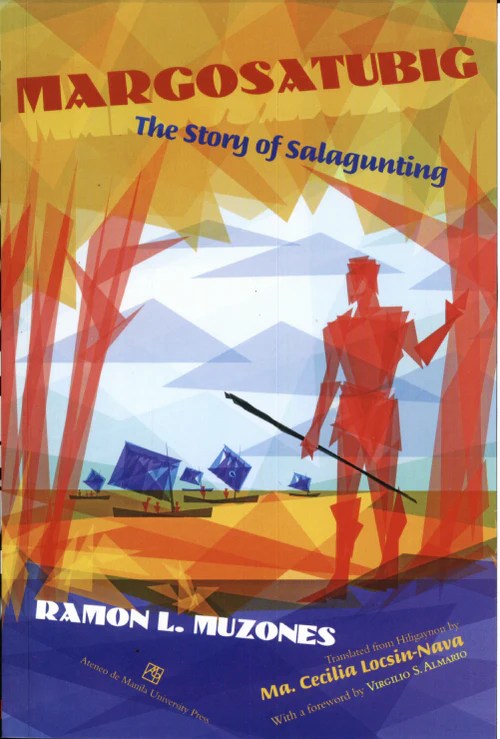


 The Infinite Library and Other Stories