The Sands of Pactolus

Pactolus is a river in ancient Lydia (now Modern Turkey) where the ancients once mined gold and electrum. It was said to be the very place where the legendary King Midas divested himself of his golden touch by washing himself in the waters.

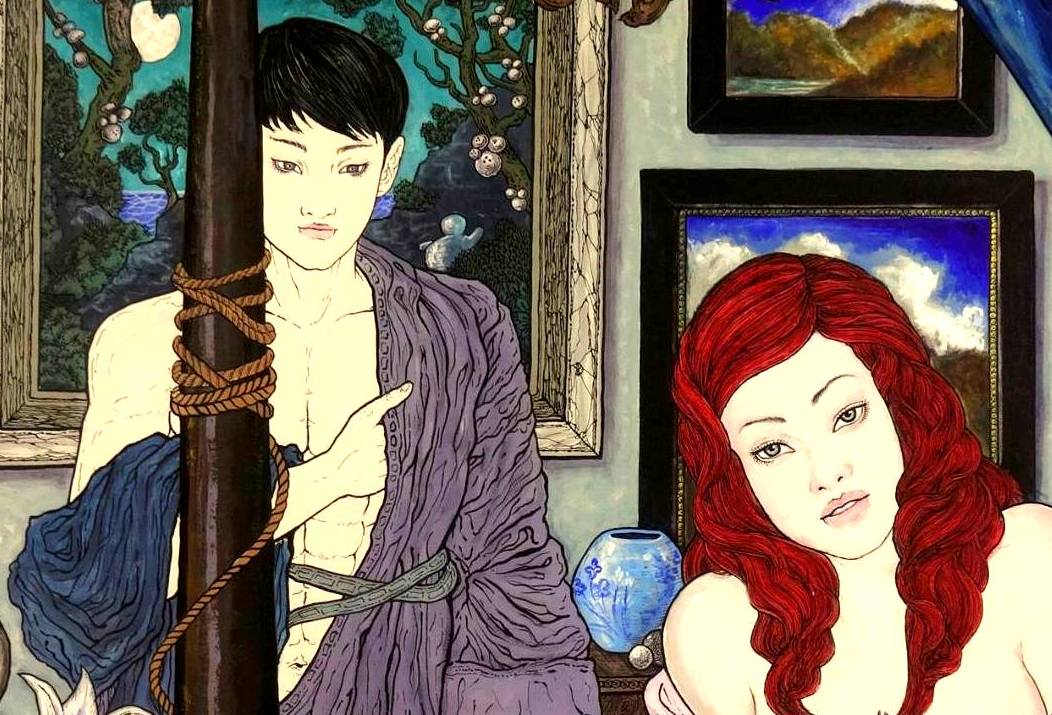
The Sands of Pactolus” is also the title of Pop Surrealist/ Neo-Symbolist Gromyko Semper’s first solo show in Singapore (c/o Artesan Art Gallery). If you are in Singapore tomorrow please catch the opening on Thursday 7pm, May 28, 2015 at Artzpace 1, Nassim Road #02-02 Singapore 258458.

Sands of Pactolus

From his bio:

“Semper’s drawings are executed in the manner of Japanese wood-block prints, whilst embodying a personal, invented mythology like William Blake and J.R.R. Tolkien; the symbolists, surrealists and decadents; and up to and including British artist Patrick Woodroffe’s Mythopoeikon (1976) and The Pentateuch of the Cosmogony (1979) and the forerunner of Vienna School of Fantastic Realism, the visionary, Ernst Fuchs. Whilst Semper’s work has some affinity with Albretch Durer’s woodblock style, it stands apart, drawing on Filipino supernatural folk traditions, Christianity, Jungian psychology, the mysteries of the Kabala and Gnostics whilst employing elements of quantum mechanics, alchemy, world mythology, the occult, classical art symbolism, art nouveau and erotic drawings.”

Gromyko also illustrated one of my short stories “A Secret Map of Shanghai” (which originally appeared in Strange Horizons). This will be included in a future collection of my short stories. Here’s a teaser:

ASecretMapof Shanghai.-Detail


Another New Post on #WhereGhostWordsDwell

“Another monster jumped from behind and the two rolled down the small mountain outcropping, with the aswang’s bony hands clutched around his throat. Pipit struggled to fight it off but was instantly mesmerized by the creature’s face. Despite the yellowed eyes and the pallid grey complexion, its features were almost comely, like that of a young maiden’s. ”

Check out the new mystery post on ‪#‎whereghostwordsswell‬

aswang_by_ejieart-d5ddzmd

Aswang by ejieart on DeviantArt

Introduction to Likhaan Volume 8

A big “Thank you!” to the editors of Likhaan Volume 8 — Gabriela Lee (Managing Editor), Rosario Cruz-Lucero (Issue Editor), as well as associate editors Heidi Emily Eusebio-Abad and Eugene Y. Evasco for the great intro to my story “An Excerpt from the Philippine Journal of Archaeology (04 October, 1916)” which I quote, in part, here:

“An Excerpt from the Philippine Journal of Archaeology” unfolds in the same way that an archaeologist sifts through the sand and dusts off the crust of soil stuck to a piece of ancient pottery. It adopts as its fictive mode an archaeologist’s report about a race of people whose remains are discovered on a slope of Mt. Pinatubo. Thus, one might mistake this piece of fiction as a handful of pages actually torn from a fieldworker’s journal. However the American archaeologists names allude to H.P. Lovecraft’s own fictional characters and an urban legend about Rizal’s kinship to Hitler.

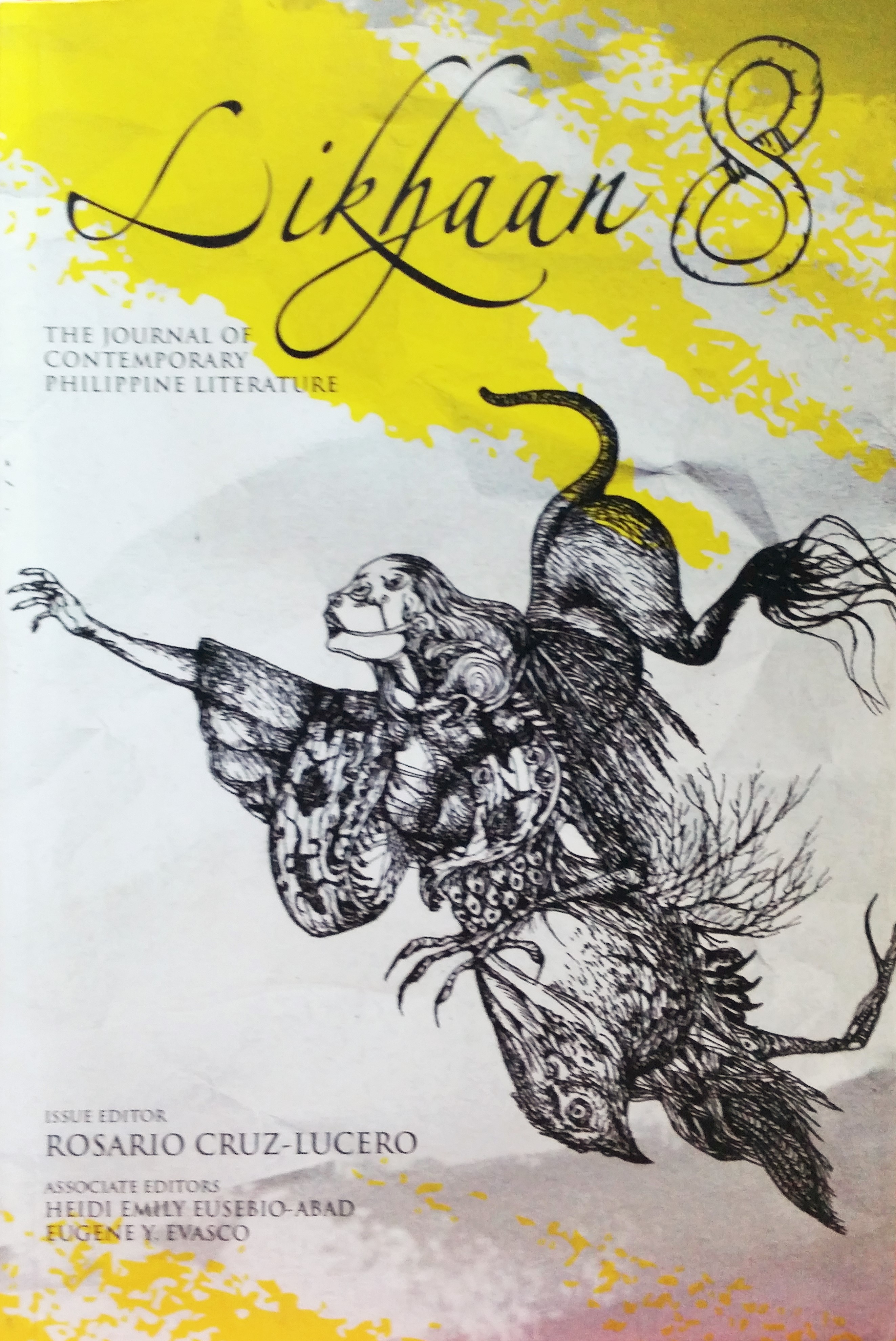
And here is the very interesting cover –

Likhaan 8 Cover


Where GhostWords Dwell Update

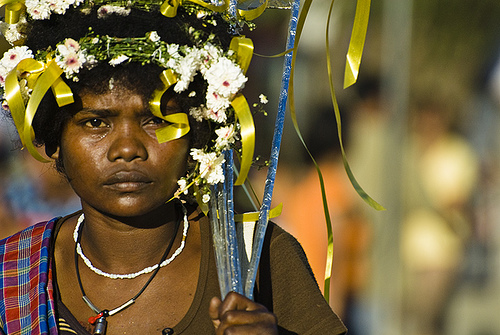
The Aeta are the original people of the Philippines and they tell the country’s oldest stories. Despite this, there are not many stories about them. Sadly, this is a reflection of how neglected they are by modern society.

This week’s mystery post on ‪#‎whereghostwordsdwell‬ features an Aeta mother and her unborn child.

There are many secrets buried in the text and the empty spaces between words. See if you can find them all.

aeta1

Picture from the blog “A Crucial Flight

Where Ghost Words Dwell

Where Ghost Words Dwell” is a new, really interesting Exquisite Corpse-style writing project.  As its about page declares: “The entries carry no author names and are extracts from works that have been published or are on their way to being published. They could also be alternate versions that ended up on the editing floor. To find out who the author is or what work the extracts are from, click on the highlighted links. Who knows, you may find a new favorite writer or a work you haven’t yet read.

Many marginalized writers are also involved in this project so please check it out.

Ghostcover

“Blessed Are the Hungry” in Science Fiction World

I am so honored to announce that “Blessed Are the Hungry” (which originally appeared in Issue 62 of Apex Magazine) has been translated into Chinese by my friend Hu Shao Yan. It appears on this month’s edition of Science Fiction World! This magazine has a circulation of about 130K subscribers and a readership of close to one million people, I still can’t believe they accepted and published our work. I have been told that this is the first time they have published a story by a Filipino author.

For those who still have space on their Hugo ballot this year, please consider my little tale of a Filipino family on a Generation Ship for the Short Story category.

BlessedSFmagCN

What you should know about the 2015 Palanca Awards

The Carlos Palanca Foundation is now accepting entries for the 2015 Carlos Palanca Memorial Awards for Literature in the Philippines. Apart from the fact that you can only submit unpublished works now, the biggest and perhaps most disturbing change is that winner will now be obliged to sign over all their moral rights to their winning work. You can find more about Philippine Intellectual Property rights here and an update here.

Here’s the excellent original post by Tin Lao on Facebook.

(This note was modified on March 5, mainly to say that authors can waive their moral rights under the law, but the waiver will not be valid under certain situations; and that moral rights last forever, beyond the +50 years after death (pre-2013 provision). Thank you, Drea Pasion-Flores, for pointing these out to me.)

The 2015 Palanca Awards entry rules bother me very much. I’m quite curious what interests the changes seek to promote or preserve. I hope this is not a case where overzealous lawyers have crafted rules to protect the client but end up defeating the client’s ultimate objective (which, I’m guessing, is to attract the greatest number of good writers to join the competition).

Future and past winners might wish to check what they will be assigning the contest sponsor:

1. Not only “the concurrent and non-exclusive right to exercise the full copyright and all other intellectual property” over the winning work, BUT ALSO the intellectual property over the contestant’s PREVIOUS PALANCA PRIZE WINNING WORKS.

Meaning to say, if you won before (and the rules didn’t then require that you assign full copyright to the sponsor) and win again in 2015, you’d be assigning full copyright over even your past winning works, which have nothing to do with the current contest. In effect, you’d be giving the sponsor the right to use and distribute (and more, see below) your past and present winning works.

(Caveat: This right is concurrent and non-exclusive–meaning to say, when you assign it to the sponsor, you still exercise it too. But what if Past Winning Author isn’t too keen on sharing copyright over her previous winning works? This might actually discourage her from joining the 2015 contest.)

(By the way: What IS copyright? Under the Philippine Intellectual Property Code, the right to carry out, authorise, or prevent the following:

Reproduction of the work
Dramatization, translation, adaptation, abridgment, arrangement or other transformation of the work
The first public distribution of the original and each copy of the work
Rental of the original or a copy of the work
Public display of the original or a copy of the work;
Public performance of the work; and
Other communication to the public of the work.

Copyright is an economic right–therefore, a copyright holder can derive profit from doing or allowing anyone to do the foregoing activities. If you assign copyright to someone else, you’re allowing that person to profit from doing any of the above activities. It’s the copyright holder, for example, whom you need to ask permission from, if you would like to turn a written work into a movie. The copyright holder might give permission in exchange for a fee. Here’s an interesting hypothetical situation: a theatre group knows that you dislike its work. And so, instead of getting permission to perform your play from you, they strategically go to the person you assigned non-exclusive copyright to. If that person allows the group to perform the play for a fee, it would have no obligation to share with you the fees it collected from the theatre group.)

2. All moral rights over the winning works are waived, in the sponsor’s favor.

What are moral rights? From the Intellectual Property Code of the Philippines: The author of a work shall have the right:

– To require that authorship of a work be attributed to him or her
– To alter the work before its publication or to withhold it from publication
– To object to any change to one’s work
– To restrain the use of one’s name with respect to any work that she did not create (or which is a distortion of her work).

Moral rights are different from but connected to copyright.* Sure, sponsor, go ahead and exercise full copyright over the winning work (concurrently with the author, that is)–but ask a contestant to waive one’s right to be associated with the work as its author too?

Andrea Pasion-Flores points out that Sec. 195 of the IPC does provide that authors can indeed waive their moral rights but this waiver is not valid only if the work is used to “substantially tend to injure the literary or artistic reputation of another author” or to “use the name of the author with respect to a work he did not create”.* But what if the person favored by your waiver uses one’s work without attributing it to the author?

In fact the 2013 revisions to the Intellectual Property Code (IPC) provides that moral rights cannot be assigned or licensed, and shall last during the lifetime of the author and even after his death.**

3. Finally, the rights one assigns to or waives in favor of the sponsor are “worldwide, continuous, and exercised for the maximum time allowed by the law”. Sure, the copyright one has assigned to the sponsor is nonexclusive and concurrent–but some markets do ask for first exclusive publishing rights in a particular region of the world. This would limit the markets that one might wish to bring the work to internationally. (But then again, if one self-publishes, or is happy/lucky enough to find reprint markets, this shouldn’t be a problem. Even so, I can imagine some people might be bothered by this.)

Oh yeah, and this year, only unpublished works can be entered. Posted it on your blog? Sorry. It’s now “a work available to the public by wire or wireless means in such a way that members of the public may access these works from a place and time individually chosen by them.” (IPC 171.3, as referenced by the CPMA rules) This mode of communication to the public already disqualifies your work.

Of course, one is free to enter the contest or not. However, I think it’s only fair that people who enter it know what they’re giving away in exchange for the prize money and prestige of winning the contest. 🙂 (I actually don’t like that we treat the contest as an exchange/ transaction of this sort, but intellectual property rights discussions ARE about business transactions.)

Then again, as one of my copyright-friends has suggested, there’s always this option too: Join, win, publish own version, upload on various electronic platforms, make derivs. :))

Update: (c/o Tin Lao) No more waiver of moral rights; no more retroactive assignment of copyright over past winning works. One still assigns the sponsor nonexclusive copyright over the winning work (meaning, you both share copyright over the winning work). More details here.
Call for Submissions: ‘Philippine Speculative Fiction 10’

It’s hard to believe that PSF is a decade old already. Pinoys abroad, we make up 10% of the Filipino people, let’s add our voices to this.

PSF Tile

From Dean and Nikki Alfar –

Call for Submissions: ‘Philippine Speculative Fiction 10’ – your atTENtion, please!
‘Philippine Speculative Fiction’ is turning ten this 2015! Yes, it’s been X years of eXtolling, eXploring, and eXpanding what Filipino writers have done, are doing, and can do in the realms of science fiction, fantasy, horror, and all things betwiXt, between, and beyond.
Editors Dean Francis and Nikki Alfar would love for you to be a part of this year’s landmark volume of this trailblazing annual anthology, which has repeatedly been shortlisted for the National Book Award, and multiple stories from which have frequently been cited in roundups of the year’s best speculative fiction across the globe.
First-time authors are more than welcome to submit; good stories trump literary credentials any time.

Submissions must be:
1. speculative fiction—i.e., they must contain strong elements and/or sensibilities of science fiction, fantasy, horror, magic realism, alternate history, folklore, superheroes, and/or related genres and subgenres
2. written in English
3. authored by persons of Philippine ethnicity and/or nationality
Submissions are preferred to be:
1. original and unpublished
2. no shorter than 1,000 words and no longer than 7,500
3. written for an adult audience
In all cases, these preferences can be easily overturned by exceptionally well-written pieces. In the case of previously-published work, if accepted, the author will be expected to secure permission to reprint, if necessary, from the original publishing entity, and to provide relevant publication information.

Submission details:
1. No multiple or simultaneous submissions—i.e., submit only one story, and do not submit that story to any other publishing market until you have received a letter of regret from us. But we don’t mind if you submit to contests.
2. All submissions should be in Rich Text Format (saved under file extension ‘.rtf’), and emailed to philippinespecfic@gmail.com, with the subject line ‘PSF 10 submission’.
3. The deadline for submissions is June 15, 2015. Letters of acceptance or regret will be sent out no later than one month after the deadline.
Editors’ notes:
1. Please don’t forget to indicate your real name in the submission email! If you want to write under a pseudonym, that’s fine, but this can be discussed upon story acceptance. Initially, we just need to know who we’re talking to.
2. If you’d like to write a cover letter with your brief bio and publishing history (if applicable), do feel free to introduce yourself—but not your story, please. If it needs to be explained, it’s probably not ready to be published.
3. We advise authors to avoid fancy formatting—this will just be a waste of your time and ours, since we will, eventually, standardize fonts and everything else to fit our established house style.

Authors of selected stories will receive PhP500 compensation, as well as digital copies of the book.

Please help spread the word! Feel free to copy this and paste it anywhere you see fit that happens to be legal.

Thanks,Dean Francis and Nikki Alfar, co-editors

My Writing Year – 2014

Twenty-Fourteen was a very stressful year, and as a result, my writing output was not what I’d wanted it to be.  The most significant event was a death in my family (which up to now I still cannot talk about for legal reasons).  I was very close to this person who died and the loss was very hard to bear. On top of family and work issues, 2014 also gave me my first experience being badly trolled. Since I’d already talked about that on another post, I won’t repeat it here.

Despite me being unable to write for months, my novel in limbo, and literally dozens of rejection letters, this the year wasn’t entirely lost for writing. In fact I am very thankful for what I had been blessed with. Let me share some of the highlights:

  1. How my Sister Leonora Brought Home a Wife , my off-planet Science Fiction tribute to pioneer Filipino Short Story writer Manuel E. Arguilla, was published in the inaugural issue of Lakeside Circus last March 2014 (Editor: Carrie Cuinn).
  2. Entanglement , a twisted love story set in my old school at Seguin, Texas, came out in the second volume of LONTAR: The Journal of Southeast Asian Speculative Fiction (Editor: Jason Erik Lundberg, Math Paper Press) in May 2014 . This story was set in the same universe as “Big Enough for the Entire Universe ” from Fish Eats Lion.
  3. Blessed are the Hungry , a space opera set on a generation ship mixing Filipino, Brazilian, Mexican and Igbo influences, appeared in Apex Magazine issue 62 last July 2014 (Editor: Sigrid Ellis), along with a short interview. Here’s a good review from Over the Effing Rainbow. This story was also in Medieval POC’s Best of 2014 list (Yay!)
  4. I m d 1 in 10  , my experimental Jejemon near-future story, was published in the July 2014 issue of The Future Fire (Editor: Djibril al-Ayad). “Jejemon” is a Filipino English-Tagalog argot that developed from the use of Instant Messaging and SMS. This is probably the most challenging work I’ve ever written to date. Like “Finnegan’s Wake”, it may be best read aloud.
  5. Panopticon , a Filipino cyberpunk revenge story, appeared in Philippine Speculative Fiction Volume 9 in October 2014 (Editors: Andrew Drilon and Charles Tan). This marked my second appearance in the venerable PSF series.
  6. An Excerpt from the Philippine Journal of Archaeology (04 October, 1916), a Lovecraftian fantasy story told in footnotes, was featured in Likhaan Journal 8 by the U.P. Institute of Creative Writing last December 2014 (Editor: Gabriela Lee). This is another experimental work, with the story mostly happening in the footnotes of a faux scientific article.

Somewhere along the way I also got to talk about Filipino and Singaporean Speculative Fiction on two panels at the World Science Fiction Convention (Loncon 3) last August. The first one was “The World at Worldcon: SF/F in South and South-East Asia” with Zen Cho, Rochita Loenen-Ruiz, Aishwarya Subramanian, and moderated by the always fantastic Mahvesh Murad.  The second was “Saving the World. All of It.” regarding how the concept of an Apocalypse is viewed by non-Western cinematic traditions with Aishwarya Subramanian, Engineer Yasser Bahjatt, Irena Raseta and Naomi Karmi. This time I got to be the moderator, my first time to do so at a con.

Panel1Panel2

My family and I also got to hang out with fans, fellow writers and many SFF luminaries at the Hugo Awards ceremony. We even got to meet George RR Martin himself, as well as GOT show-runners D.B. Weiss and David Benioff — who graciously posed with us after winning their Hugo for “The Rains of Castamere”.

georgeRR

GOT

However the best part of 2014 was finally getting to meet many fellow authors in person, whether at Loncon, Nine Worlds or the various book launches I had attended.

Nine Worlds

PSF9

Lontar2

This year looks to be even busier as a result of the fall-out from 2014. My writing goal this year is simple – to resume writing my novel and to get at least two stories published. If I manage to do this, I’ll be a happy man.

Let me end this post with a bit of trivia. Many Filipinos ran around wishing family and friends “Manigong Bagong Taon” for 2015. Most assumed this greeting meant have  “a prosperous new year”.  However, strictly speaking, this isn’t correct. The root word for “Manigong” is the old Tagalog word “nigo”    which is synonymous with “asinta”, or in English ” to aim/to plan”. When we wish someone “Manigong Bagong Taon”  we are actually saying “May you achieve what you aim for this year“.  For me, this is a really wonderful thing to say.

Manigong Bagong Taon everyone! Thanks for reading.